'Pacific Rim' Vs. Real World Physics: Giant Robots, Galileo, And The Square Cube Law
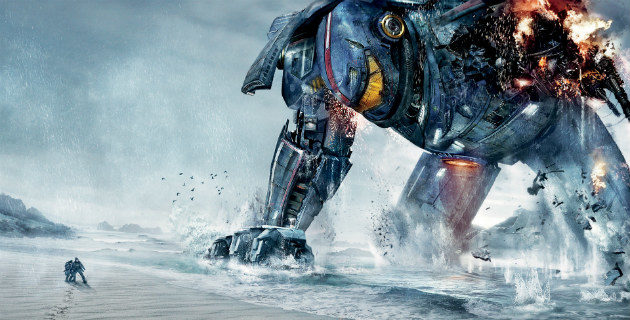
The square cube law also affects constructed objects. Aircraft, for instance, need increasingly bigger proportional wingspans the larger the plane, until they get so big they're too heavy to get enough speed to take advantage of whatever lift their giant wingspans can provide. (Imagine a Boeing 747-sized flying monster try to take off. Those broken wings ain't ever going to learn to fly again.) And buildings, for that matter, have a natural limit to their size as well; without modern support structures most skyscrapers would collapse under their own weight. And, in case we forgot, robots would affected too.
Giant robots would have to contend with the way the square cube law affects both biomechanical processes and constructed objects. Lubricants that keep the machine from overheating and freezing up would have to travel enormous distances in incredibly short periods of time, something anyone familiar with city-sized plumbing systems know would be a serious problem. Gigantic, powerful motors, gears, levers and the like would be required to move the machine's monster-sized limbs in earth-normal gravity. And of course, these processes would have to be able to do so despite the machines' incredible weight**.
That's another issue — weight distribution. A giant humanoid machine would, as we've seen, be insanely heavy - all that weight supported by the machine's two humanoid legs. Those tow legs then become points through which the machine's enormous bulk is focused. Those legs are going to punch through anything remotely pliable – dirt, sand, grassland, concrete, streets, etc – like a knife plunging through a graham cracker. Oops.
The epic battle between giant robot and giant monster? In real life it's going to involve a fragile robot sunk waist-deep in the ground, punching slowly and feebly at a heart attack-suffering reptile reduced to the humiliation of using a skyscraper-sized mobility scooter just to forage for food. Forget spending billions developing mecha; all humanity needs to do is wait for the creature to pass out, which should be about 15 minutes after it begins its attack.
Obviously, I don't want to watch that version of Pacific Rim – unless it ends with the UN establishing a chain of monster burger restaurants as a way of funding the rebuilding effort. So I'll go in ready to accept the premise with a open mind and heart. But for the love of science, let's hope they at least a throw in a stray line of dialogue explaining how these things are even possible. Nothing too elaborate, just a simple “It's a good thing we went back in time and punched Galileo,” or “Thank heavens we completely pwned the square cube law at the same time we invented cold fusion.”
On the other hand, that skyscraper-sized scooter sounds pretty awesome. Maybe bring it out for the sequel?
** No doubt this is why most of Voltron's battles take place in space.
READ MORE ON PACIFIC RIM:
WATCH: Do The Jaeger Meisters In New 'Pacific Rim' Trailer Defy Logic?
WATCH: 'Pacific Rim' Trailer Dares Mayan Calendar To End The World
Ross Lincoln is a LA-based freelance writer from Oklahoma with an unhealthy obsession with comics, movies, video games, ancient history, Gore Vidal, and wine. Follow him on twitter (@rossalincoln).
Follow Movieline on Twitter.
Pages: 1 2
 Subscribe to the new Movieline on YouTube


Comments
Nerd.
The best possible kind.
Interesting. Now you owe it to the dreamers to explain how our beloved monsters and mechs (or jaegers) can be made plausible.
I’ll be watching, and waiting.
Interesting article, but seeing as this films based around monsters that come through a dimensional rift, well that MacGuffin is all that's needed to explain their biology, as for the Jaegers, perhaps around the very same rift, some kind of ultra light and ultra durable alloy (that can be manipulated by hopes and dreams to create the bad a$$ machines we'll be hopefully enjoying when the movie comes out) will be found. Pacific Rim doesn't look to have the high science of Asimov, it looks like a less metaphysical version of Evangelion and as long as Zilla doesnt turn up to spoil the fun, I'm sure it'll be at its worst a solid fun beer and popcorn fest.
SCREW EARTH THEN!! LETS GO TO SPACE!!!!! THEN WE CAN MAKE ALL THE EPIC MECH SUITS WE WANT!!!!
The monsters are so large they adapted to the water and Earth's crust pressure when they lived under it. So once they are on the surface the gravity for them is much easier to bare, this is why they move fast. Their muscles feel stronger. You can ask how is that possible that they've developed at all, well... it's a mystery. Maybe they were born inside the magma of the earth, eating giant crystals. I don't know, maybe they have hot air chambers in their body to inhale air that makes them light, whatever.
The robots have anti-gravity technology, making them lighter, like in zero gravity. But when they move or fight, the anti-gravity distributes the weight in such manner they can walk and punch very hard, and can defeat the monsters.
It's not supposed to be scientifically correct. It's a movie about giant monsters that come through a pandimensional portal in the ocean floor as well as a throwback to kaiju films.
Giant robots aren't realistic?
YOU DON'T SAY?
Thoughts on physics...
1. An Artic Cat tractor can go on ice thinner than we can, because its weight is more evenly distributed.
Why is this relevant, well, what is the proportions being spoken of here? If it's a bipedal human form, it may sink into the earth, but is it sinking in any more than if we were to walk in mud? Probably not...
2. The scale of square is not necessarily the relevant factor. The scale of mass is. For example, I could scale up a human to 80ft. It'd be bad. Humans are mostly water.
But scale up a human form to 80ft. Use an advanced hitherto unknown alloy 100x stronger than steel for the skeletal structure. (Not as implausible as one might think.) Construct the exterior to function as an exo-skeleton. Providing double the structural support. And keep 90% of the internal area "empty" space. That's right. The unit should mostly be empty. (Actually, I'd argue most of the interior space would be designed to circulate and pump air along thin metal fins in order to cool and extract excess heat out of the unit.
3. Stability, stability is going to likely be a mix. First you have numerous muscular fiber bundles that are computer controlled. Think Segway and numerous other self balancing devices. And let's not forget the agile quadrocopters. Then combine that with a fusion reactor turbine, Two actually. Both spinning larger circular systems. In an effect - giant gyroscopes.
4. Darn it, a little imagination. But as anyone knows. It's a matter of materials and designs. We build numerous bridges and buildings today that 150 years ago would have been thought impossible. The Burj Dubai, the Russky Bridge and the Three Gorges Dam. Structures that would have been considered impossible to build. Heck, the Burj Dubai seems nigh impossible even though it's built.
But advances in design, and materials engineering has allowed those structures to be built.
- All super mecha jokes aside, I have a question: How do the monsters escape through an 'interdimensional' portal at the bottom of the ocean without draining the entire Pacific Ocean ? I don't think they can turn it (the portal) on and off at will. Just saying.
Your articles are for when it abulostely, positively, needs to be understood overnight.
- And - how do they 'push past' the torrent of the water pouring in without getting sucked back down due to the whirlpool on the other side ?
Who ever wrote this article seems to forget that science is continually destroying previously limiting laws of physics and establishing new limits. For a long time science considered it impossible to break free of the gravity of Earth or that anything could exceed the speed of light, but both of these assumptions have been proven wrong. he laws dictating size limits is also disregarded as technology improves. The Egyptians could never have built a building like Taipei Tower or Burj Khalifa yet it is possible with modern technology. In many instances science fiction gives way to science fact, simply because someone followed an idea and made it possible. Modern flight would not be possible if people had not dreamed of flying as birds do, nor would we have people in orbit around the planet if not for others wondering what was out there and if it was possible to get there. Time is the only limiting factor in truth, for in time what we believe is impossible may very likely become possible or even common place.
No object of mass has ever exceeded the speed of light (in the strict sense). Einstein's theories of relativity are 100 years old and have been shown to be correct in every verifiable way possible to date.
Hmm, if I were to build a giant robot, yes mass would be a factor, so to get around that problem... one would have to find away to deplete normal matter of the Higgs Boson. Its supposedly statistically there, so perhaps in a future syncrocyclotron one could build something like a gravity based penning trap to catch it before it reintegrates. That would give you the structural material to build said giant robot. Or like in star gate invent an inertial dampener. Anyway, the next big issue is power, I really don't like fission / fusion based power supplies cause unless you find a reaction that purely generates electrons at potential, you have a ton of waste heat to deal with. My fave would be the Arc Reactor concept. You take some new metaloid, make a toroid out of it, coat it with a fancy refracting insulating polymer, wrap some room temp super conducting wire around it, use ac induction to bring the reactor to life, and get Q gain on the secondary coil, note: can only build one of these in a cave or back ally Russian based work shop. Or my next favorite power source would be anti matter, but that stuff is really dicey... one itty bitty loss in confinement and good by billion dollar robot and am your 10 trillion dollar kilo of anti matter. For a good example of how really big machines behave, check out the speed of the space shuttle transporter and the foot print of the Big Musky walking drag line.
In the example you give, wouldn't the person's heart also increase by a factor of 8? After all, their heart is a volume, just the same as their circulatory system. Every organ should scale up by a factor of: V=w*l*h -> w*l*2h = 2V or w*l*h -> 2w*2l*2H = 8V, if you prefer. The real problem would be that there is now much more heat being produced, which dissipates through the surface area, which only increases by the square. Alternatively, the problem is not that the heart's volume increases at a slower rate than the rest of the body, but that the force required to pump a certain amount of blood a certain distance increases more than linearly. Thus, although the person now has a heart 8X as big, to pump blood 8X as far it has to work 16X. (I'm not sure of the actual equation for the force required to move liquid a certain distance.) Still, the problem isn't with the size of the heart, it's with dissipating the heat output or the force required. Am I misinterpreting?
Yes, that post is misstated. The heart will be 8 times as massive/heavy, just like the rest of the body. The problem is that the heart's muscle strength, or blood pushing power will only be 4 times as strong. Same goes for every muscle and bone in the body. 8 times as heavy, 8 times as massive, only 4 times as strong, only 4 times as durable. At some point the weight/mass will overtake the strength/durability. An elephant is unbelievably powerful, but it can be killed by it's own weight i.e. falling.
The "Square-Cube Law" is also why Voltron is a cartoon, and why the Zords and monsters on Power Rangers are models.
I think the movie's science is terrible, but this is yet another article where most of these aren't actually problems. The Kaiju aren't made using earth biology... although they seem to have organs, you can just insert whatever exotic materials, since they bleed floursent blue toxic waste, I'd say comparison to elephants and mice is almost as silly as they are to begin with... why would you think the mouse model would work when the monsters are composed of unknown chemicals?
As for the machines, I see other people have covered the topic already above. The Jaegers seem to be mostly hollow and are composed of uknown materials tech. It's dumb to build a weapons system like that anyway.... that's really a much larger problem.
I have to say, sometimes too much physics confuses you. Every physics student seems to begin restating the problem with the unspoken "Assuming the mass is evenly distributed and it's a geometric solid... "
Of course that often works and simplifies the problems, but engineers must all now begin rolling their eyes and shaking their heads. Well, as long as it's all academic, be my guest.
Newton never expected someday skyscraper will be built,he would have said skyscrapper will collapse on it own gravity(he didnt know about steel).Enstein never thought his E=mc2 is feasible until he saw world going nuclear.They all underestimated technocrats.What if jaeger's feet & its lower legs are made of steel & irridium and rest of the body with titanium.Also some parts by graphene.Not talking about cost now.
I think Graphene would be required for almost all the parts, as the whole robot would just be too heavy otherwise. And Graphene is much stronger than any other material anyway.
the dual driver mind thing was just way to far out i mean how stupid is this writer we can control robots using a suit now size would not matter ask any crane driver
Actually, the Kaiju should suffer from the same problem, yet can FLY.
I think the Kaiju, being from a parallel dimension, don't follow the same natural laws we do, and thus neither do the jaegers, made using science founded in Kaiju biology.
Correct
As I position possessor I consider the content background at this juncture is rattling fantastic , appreciate it for your unbreakable job. You should keep it cheery forever! Finest of luck.
Utterly composed written content, thank you for entropy.
You forgot to mention that the sea water was wet.
I believe this is among the a lot major info for me. Exactly what glad mastering a person's report. Yet would you like to remarks in number of staple items, The site design and style is ideal, the particular articles is basically terrific : D. Great task, regards
The Main reason that we can't build giant man controlled robots is that our government can 't pay
The cost's if they do they would be broke of course there are Some problems to solve but it isn't impossible
Within the opening 15 or so minutes Charlie Hunnam's voice-over establishes the reality of a future where monsters (the Kaiju) repeatedly invade earth, to stem this humans have created giant robots (Jaegers) to combat them in increasingly badass iterations. This opening does a great job in conveying the scope of a film which is big, not just regular big, but like, Jason Biggs in 1999 bigg. entering the cinema from a world where these events rarely occur is initially a lot to throw at the audience, but it's handled so effectively and without tongue in cheek that it quickly becomes a world I had a blast experiencing. Maybe it was the incredible effects shots of robot related destruction used as a throwaway shots, but what I think really sold the opening sequence and the film as a whole is the enthusiasm Del Toro clearly has for the story he's telling.
The cast is essentially a rogues gallery of TV's better dramas playing variations on roles they've nailed in the past (see: Elba, Hunnam and Klattenhoff) and some inspired casting of It's Always Sunny's Charlie Day who, as should be expected provides some effective comedic relief. Added onto this the score comes courtesy of Ramin Djawadi who's masterful use of themes on Game of Thrones is carried over to this film for some great emotional cues and many a rad motif courtesy of Tom Morello on guitar.
It's appropriate Del Toro has a Frankenstein adaptation lined up as a follow up project as Pacific Rim can at times can feel stitched together from all the sources of inspiration the film has. This comes from many areas such as Japanese manga, the personalities of the actors from previous films and the imagery of robots destroying buildings which transformers ran into the ground. But Del Toro succeeds time and time again at allowing these disparate elements to fit together believably by way of some very confident filmmaking. I could easily take issue with the oft hammy dialogue and macho relationships but where the film succeeds in other areas and revels in creativity trumps the dissatisfaction one could take from these scenes. I also found Hunnams character a tad lacking in charisma and internal conflict but whatever, it's not the end of the world. Oh wait, yes it is hahahaha…
The films successes go beyond its imagery and continued invention within battle scenes as the script is very economical when it comes to pacing. The films battle scenes are so engaging and exciting due to clearly established stakes present which left me devoid of the "action fatigue" transformers loves to throw my way. And although the Kaiju battles seem to never be in short supply, the film essentially follows the rule of three when it comes to battle sequences and left me oh so satisfied.
In conclusion, I give it points for being one of the funner summer blockbusters in recent memory, for being an original property and for its sheer tenacity to exist which all amount to what is just a darn good time at the movies.
More about the movie you can also find it here
http://movieinfodb.com/en/movie/68726/Pacific+Rim-2013
You're truly a just right webmaster. The web site loading speed is amazing. It sort of feels that you're doing any unique trick. In addition, The contents are masterwork. you've performed a fantastic activity in this topic!
Explain Sauroposeidons then. Those dinosaurs were freaking huge.