Quentin Tarantino's 'Django' Klansmen Inspired By John Ford: 'To Say The Least, I Hate Him'
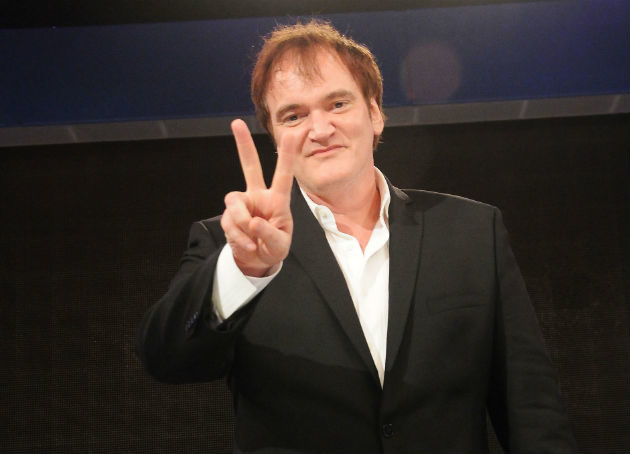
John Ford may be one of American cinema's great directors, but Quentin Tarantino has some choice words for the maker of such film classics as The Searchers, Stagecoach, and The Grapes of Wrath: "To say the least, I hate him," Tarantino told The Root in a recent conversation about Django Unchained. What's more, he says Ford inspired him to write a scene in Django Unchained in which comically inept proto-Klansmen get their just desserts.
Earlier this month, Django producer Stacey Sher alluded to Tarantino's animosity toward Ford at the film's PGA screening. "He’s not a John Ford fan," she said. "Do you know why? John Ford was a Klansman in Birth of a Nation, so Quentin can’t really get past that — and I can’t blame him."
That's terrifically provocative and explanatory a statement in itself, but in a fantastically in-depth interview at The Root, Tarantino explains the Ford beef further:
Oddly enough, where I got the idea for the Klan guys [in Django Unchained] — they're not Klan yet, the Regulators arguing about the bags [on their heads] — as you may well know, director John Ford was one of the Klansmen in The Birth of a Nation, so I even speculate in the piece: Well, John Ford put on a Klan uniform for D.W. Griffith. What was that about? What did that take? He can't say he didn't know the material. Everybody knew The Clansman [on which Birth of a Nation was based] at that time as a piece of material.
...he put on the Klan uniform. He got on the horse. He rode hard to black subjugation. As I'm writing this — and he rode hard, and I'm sure the Klan hood was moving all over his head as he was riding and he was riding blind — I'm thinking, wow. That probably was the case. How come no one's ever thought of that before? Five years later, I'm writing the scene and all of a sudden it comes out.
One of my American Western heroes is not John Ford, obviously. To say the least, I hate him. Forget about faceless Indians he killed like zombies. It really is people like that that kept alive this idea of Anglo-Saxon humanity compared to everybody else's humanity — and the idea that that's hogwash is a very new idea in relative terms. And you can see it in the cinema in the '30s and '40s — it's still there. And even in the '50s.
A true cinephile controversy! (Read/listen to the whole interview here.) Pot, consider yourself stirred. Discuss!
[The Root h/t @GlennWhipp]
 Subscribe to the new Movieline on YouTube


Comments
Fuck yeah QT! I can't believe that asshole played an extra in a movie! Make fun of people w/ eyepatches next! Von Stroheim was an extra too! What about making fun of monocles next in your movie where homosexuals mete out pastiche-fantasy violent revenge on hetero society and you cheapen the actual facts of their actual sufferings and actual uprisings? You're such a genius! I hate your earlier movies where you didn't have this foolproof formula of marginalizaton+fantasty revenge=easy box office. Don't ever read another Elmore Leonard book again, please. Just keep smoking pot until your last sensibility dulls over and you're making comic book movies like everyone else, shithead.
Wow. You missed the point ENTIRELY.
Not sure I see where he missed the point. Von Stroheim did claim to be an extra in BOAN. Which is -- as everyone knows -- a vile film, but Griffith also made Broken Blossoms and Intolerance, so there's no reason to throw out HIS work altogether either.
You might want to brush up on WHY being an extra in one of the most reviled, racist, offensive movies in the history of film could be such an anathema to anyone with decency.
http://en.wikipedia.org/wiki/Birth_of_a_nation
Good article; QT should read it, then watch Fort Apache: http://www.nytimes.com/2012/03/25/movies/homevideo/john-fords-fort-apache-on-blu-ray-from-warner-home-video.html?_r=0
"...it was among the first of the postwar “pro-Indian” westerns. Ford treats his Apache warriors with sympathy and respect, depicting them as fully justified in their revolt against the deceitful and exploitative policies of the United States government..."
John Fords treatment of Native Americans in his movies alone deserves every bit of Quentins hate. Watch "Reel Injun" and your opinion of Ford and John Wayne will change drastically.
Strangely, Indians themselves don't seem to share your opinion. From Tag Gallagher's book on Ford: 'One reason he filmed so often in Monument Valley was that his Navajo friends needed the money his projects brought them. He paid them union wages at a time when Indians were not commanding even fifty cents a day. He studied their language, played their sports, was adopted into their tribe, and named Natani Nez, 'Tall Soldier.' A blizzard covered the Valley in the fifties, and Ford got army planes to drop food in. "To the Navajos," said Harry Goulding, who operated a lodge there. "Mr. Ford is holy, sorta." '
If you have another look at the cavalry trilogy you'll find a surprisingly nuanced view of Indians. Often they are voices of reason in the face of Army stupidity. And John Wayne typically portrays the lone soldier who understands them.
I quote that passage from Gallagher's book quite often when I talk about Ford.
To be fair, did Ford ever put Navajo characters in his movies? Because it seems to me he always cast them as Apache, Cheyenne, or Comanche. So...a case could be made that the Navajos were a-OK with it because they didn't have a dog in the fight.
I saw "Reel Injun" and it is a very partial story of natives americans in movies. They attack Wayne and Ford because they were icons and i thinks they do not really understand these movies. There were a lot of racists westerns, a lot of them ridiculous, but even if Ford made classics ones (Rio Grande), He is also one of the first who change the point of view about the natives americans like in "Fort Apache" and "She wore a yellow ribbon". The documentary talks about "Stagecoach" and the final pursuit, but doesn't talks about "Fort Apache". When they show a piece of "Searchers", they comment : "it is racist", but they doesn't says that the movie is about a racist. It is not honest, and they got Ford wrong. Ford was a very complex man. There were things unpleasant with him, but his strength was to use this "dark sides" to make his movies. that's why his his and will remains one of the greatest film directors.
Um...Ford knew about how he portrayed Native Americans in his films. He described his film Cheyenne Autumn as his "film of atonement" to them. Later in his career he was not really given a chance to make many movies. In the late fifties and early sixties he made many movies with Woody Strode. If you watch Sergeant Rutledge, and consider the year it came out, 1960, and the subject matter, I do not see how you can classify Ford as racist trash. For that matter, Ford being in Birth of a Nation is still open to debate as far as I know, Ford was fond of throwing out bullshit stories to people all over the place. When he was asked which Klansman he was he would respond, "the one with the glasses". Suppose he was in it, fine...he was around 19-21 years old. John Ford helped start the director's union. His parents were Irish immigrants in Maine. He was a generation older than Kennedy. His brother was a silent film star and director. He often collaborated with James Warner Bellah, who was a bigoted weirdo. Was Dudley Nichols? In the Horse Soldiers, a film that is often dismissed for various reasons, the Southerner types are generally portrayed as wrong or somehow fanatical. What of the slave helping the master plot against her liberators? Just what does Samuel L. Jackson's character do again in Django? Sergeant Rutledge and Cheyenne Autumn are two movies this man did not have to make but did, to the detriment of his own fading career. Woody Strode helped care for him in his later years, often in a manner that would be more familiar to one's son or even a nurse. One biographer took note of some shots in The Man Who Shot Liberty Valance of George Washington being in a picture hung on the wall in the background behind Jimmy Stewart (who was himself, bigoted against black people) and Abraham Lincoln in a picture behind Woody Strode's character, Pompey. The Last Hurrah, another under appreciated late Ford film, deals DIRECTLY with class and racial discrimination in the political process. He served in WWII, he ran a photographic documentary/propaganda/surveillance naval reserve unit that he started. Far from a perfect man, he remained a patriot type, but often showed his hand on John Wayne, who, despite loving him like a son, thought he was a Hollywood phony about military/war matters because he didn't serve. He once helped to stop Cecile B. DeMille and others in the old director's guild to not go with the McCarthy-Commie scare and expose members to the government with a speech that was generally thought of as humble, quiet, and unassuming at a guild meeting on the matter. But no, let us not take this man from the content of his character, what we know about him at least, in detail, as a whole, and think of him as a human being, let's judge him for working as an extra on the biggest movie of its time, such as it is, if indeed, he actually did that. Ford was Irish and Catholic (externally on the latter) so he'd be off the actual Klan's list, Quentin.
He does remember The Searchers right? He has too....hes a cinephile. I love Tarantinos movies, but he seems to take the opposite position on films and directors you'd expect. He also claims to not like Hitch films even though Basterds is essentially a love letter to them.
It's not true that he doesn't LIKE Hitch (watch the Hollywood Reporter roundtable with him--he's got nice stuff to say about him). He doesn't think of him as one of his major inspirations, that's all.
Well said...! Thank you for helping me think about that matter....
He also talked shit on Roots because he's trying to make himself the only person who knows how to tell a story about black suffering. He ain't a hair on Ford or Alex Haley's ass. Tarantino's ego is so enormous and insufferable, he's starting to make M Night Shyamalan look humble.
I saw Django and to me he treated every black character apart from Fox's and Jackson's like a faceless person. He is very proud of doing a slavery revenge film but, Django the main character is simply a sideckick to the suspicously kind white man, Dr. Schultz until the last 10 minutes of the film.
Ditto to everything James DeLoss wrote. I like most all of QT's films, but he is astonishingly ill-informed about Ford if that's all he's taken from the man's incredible career. It's also a fair bet he's never seen THE SUN SHINES BRIGHT or SERGEANT RUTLEDGE, or misunderstood them if he did. Ford was a complicated artist, and he loathed explaining himself, so we're left with the work, which can be interpreted or misinterpreted in many ways. As others have mentioned, he was flawed, and he evolved, and undoubtedly his older self regretted aspects of his youth, but if you dismiss him as an artist because of his flaws, you're dismissing some of the greatest films ever made.
"Astonishing ill informed"....absolutely go***m right. It's shocking that QT, a filmmaker who (I thought) had a huge knowledge of cinema, would speak so disparingly and naively about Ford. John Ford was a deeply complicated artist/man.
and speaking of extra work - Elvis Presley's whole career was stealing from black people yet Tarantino played an Elvis impersonator extra on an episode of Golden Girls. That and the rampant N-word use (and severe lack of visually timeless compositions) should still put Ford ahead in this fight
Very impressive post by James Deloss. I had the occasion to meet and speak with John Ford in the mid-1960's, when I was a student at UCLA Film School. Ford lived just across Sunset Blvd. from the NE entrance to the campus, at 125 Copa de Oro. We screened a beautiful Warner Bros. "studio print" of "The Searchers" (10 minute reels instead of 20 minutes), then Ford arrived for a Q&A. Unlike his treatment of many other interviewers over the years (such as Peter Bogdanovich), he was gracious and generous with us film students, and answered all our questions about his films and filmmaking. I remember quoting some dialogue and character's names from "She Wore a Yellow Ribbon", which seemed to please him. Ford often dismissed film making as just "a job of work", but in actuality he was a complex and deeply feeling artist. He had that Celtic gift of poetry, but his medium was not words but images. It's interesting to compare the screenplays to his finished films, and see what Ford cut out to leave that unsaid dialogue to the imagination of the audience. Ford was, at times, a mean cruel Irish-American drunk, but as others have written of the help he provided to the Navajo over the years, and how he stopped Cecil B. DeMille and his alliance of ultra right-wing directors from railroading [and de-facto blacklisting] Joseph Mankiewicz out of the presidency of the Director's Guild, for being "sympathetic to communism". DeMille denounced all the foreign-born directors in the Guild and all those he and his cronies accused of being commies. Then Ford, considered the "grand old man' of the Guild, stood up and successfully rebutted DeMille with a speech that began, "My name is John Ford, I make Westerns…". Subsequently, whenever he heard about someone being blacklisted, he'd say…'Send the Commie bastard to me…I'll hire him." I wrote this with much reference to, and appreciation of Scott Eyman, author of "Print The Legend: The Life and Times of John Ford". PS: John Ford stock company member Harry Carey Jr. died yesterday.
Quentin Tarantino’s comment about John Ford shows him to be an undereducated self loathing hypocritical media whore. He will say anything to get attention. His movies are all ultraviolent plot light over produced "b" movies.
He couldn't write a thought provoking movie script. If he were to make a movie without extreme violence it would be ignored by everyone. He CAN'T write dialog.
His movies are running monologues.
Sight the source of the comment and take it for what it is;stupid.
I agree with you Tarantino.
Gonna go out on a limb and say that you likely cannot state some solid reasons why.
It has been said already but QT really needs to comment on SERGEANT RUTLEDGE if he's going to throw stuff like that out there. Having a black man headline a movie in 1960 about racism and scapegoating. Very fine film.
That being said, QT is not alone in his sentiment. James Agee, writer of "The African Queen" and long-time critic, once wrote of Ford's films that they were so filled with Irish humor that he wishes Cromwell had done his job better. That's cold-blooded, right there.
Me? big fan.
I agree with Tarantino. Well said!
Tarantino would do well to actually sit down and watch a few of Ford's films... and then re-watch them, so that their meaning sinks in. He couldn't be further off the mark. Ford was an Irish-Catholic-American (NOT Anglo-Saxon), and was himself the victim of racism early in the 20th century, so he was well aware of its connotations. And the fact that he appeared in a film as KKK rider doesn't actually make him one! As for his depictions of Indians (and other races) on film, I highly recommend reading this article from Film Comment: http://www.directedbyjohnford.com/blog/general/we-never-see-look-race-in-john-ford-films/
Wasn't Akira Kurosawa a big fan of John Fords movies, which in turn let to the samurai movies such as Seven Samurai and Yojimbo which where later used by the Italian directors for their westerns such as Django and A Fistfull of Dollars?
"There is one person, I feel, I would like to resemble as I grow old: the late American film director John Ford."
Akira Kurosawa, in his memoirs.
Peter Cowie, in his essay, "Seven Rode Together: Seven Samurai and the American Western", published in the booklet accompanying The Criterion Collection's DVD of the restored full-length "Seven Samurai" outlines Ford's thematic influence on "Seven Samurai". Kurosawa has acknowledged the influence of Ford's westerns on "Yojimbo" and its sequel "Sanjuro". Kurosawa met Ford in a London hotel, when Ford approached him at the bar with a bottle of scotch…
"In London he was very nice to me. He…treated me just like his own son. I like him…".
As is well known, Sergio Leone was "inspired" by "Yojimbo" when he made "A Fistfull of Dollars" (and was subsequently sued by Toho Films for copyright infringement). Back in the late 1960's, there was talk of doing a western remake of "Sanjuro", to star Lee Marvin. But that never happened. And the "Seven Samurai" story has been used at the basis for many, many films, not just "The Magnificent Seven", the 1960 American western remake.
QT needs to go back & really watch Ford's impressive contributions, both to cinema, and in his later films, to an emerging pluralistic view of the 'true America.' I would strongly recommend viewing "The Searchers" and "The Man Who Shot Libertry Valance." How else do you signify the closing of T S or the schoolroom scene in TMWSLV? It is disappointing and even a bit incredible that QT, a cinephile with obvious talent, is so far off the mark here.
FYI Fergus, and all the other commentators who expressed an appreciation for "The Searchers". Recently published: "The Searchers: The Making of an American Legend. By Glenn Frankel. Bloomsbury, 405 pp. $28.00. Which got an excellent review in the Outlook section of the February 17, 2013 edition of the Sunday Washington Post.
In 2008 Glenn Frankel went to Monument Valley in search of the locations Ford used in "The Searchers". Some are well known but others have been forgotten. Frankel tracked them down. He wrote an article about his search for the September 14, 2008 issue of the Sunday Washington Post Magazine. Anyone interested in reading that article may be able to find it in the Archives section of the Washington Post web site.
Tarantino's comments about Ford just go to prove that Hollywood is populated by mainly the ignorant, the uneducated and the vulgar. Stanley Crouch, the African-American poet and cultural critic, loved Ford's films, especially How Green Was My Valley, because, as he said, they "gave me one of my earliest experiences of the universal achieved through aesthetic form." Ford excelled at telling stories on film that captured the universality of human experience. Trying to convince someone as shallow as Tarantino of this would probably be impossible.
I like Stanley Crouch, some years ago he made the comment…"Rap videos are the new minstrel shows." Something to think about, as a good cultural critic should make you do.
If you want an example of Tarantino's character and behavior, I suggest you read Jane Hamsher's book, "Killer Instinct" (Broadway Books. © 1997). It's her account of the making of the film "Natural Born Killers", which she produced with her partner, Don Murphy. Directed by Oliver Stone, and written by Quentin Tarantino. Tarantino does not come off well in the book…to say the least!
Funny thing is, the Native Americans loved Ford, for the most part.
QT is hating on him to get some buzz -- simple as. I'm sure he loves Ford, especially because his favourite director does. Without Ford, there would be no Django.
Tarantino you wouldnt know a good film if it bit you on the arse. Every film you have made you have stolen off someone else. To say ford is an Anglo Saxon your just a fuckin clown. As for ford being a racist because he took a part in a film!!!!!. The man was Irish catholic for fucks sake.
Tarantino loves Howard Hawks' Rio Bravo, a film that occurs mostly indoors and is more of a sit-com than a western.
But Hawks' Red River is way more racist than anything filmed by John Ford. In the first minutes of Red River, John Wayne arrives in Texas and claims some land for himself. When two Mexicans show up and tell him that he is trespassing, he kills one of them and sends the other back with a message to his boss that the land now belongs to Wayne. Descriptions of the film tend to ignore this scene, but it's clearly intended as a display of white power & mastery. It's pretty stunning in its deluded arrogance, and from there things only get more schizoid. Eventually Wayne arrives in a town to kill Montgomery Clift, but a battle to the death is upended by slapstick: a purty woman berates Wayne and Clift, who inexplicably decide to make up and be nice. Both Rio Bravo and Red River are trivializations of history, which make them perfect source material for Tarantino.
Ford never trivialized anything, even his humor was relevant. Some of the lighter moments in The Man Who Shot Liberty Valance involve a drunken newspaper editor played by Edmund O'Brien. O'Brien is such a vibrant character, he affects a Shakespearian aire, playfully misquotes Horace Greeley, and affectionately scolds and praises the citizens of the town, whom he chronicles in his newspaper. He may be a drunk, but he's an enlightened voice of progress.
When Lee Marvin gets ahold of O'Brien and nearly beats him to death, Ford shows a close-up of O'Brien's face. It's just a glimpse, a few seconds at most, but it tells us all we need to know about the effect of violence on civil society. Needless to say, Tarantino is incapable of such things. I think many of us were with him early on, but at some point he slipped into parody & mimicry and now he pushes nihilistic distortions of history that are more about sadism than anything else. He definitely needs violence (and fake-controversy) to stay afloat.
I moved to Los Angeles in 1964, when I transferred into UCLA Film School. The first time I watched "Red River" on an LA TV station, that Mexican killing scene was absent. Was it cut to fit the film into a time slot? Neither the 133 minute version, or the 125 minute voice-over version would fit in a 2 hour time slot. Or was it cut so as not create an outcry from LA's substantial Mexican-American community? Or for both reasons? The screenplay, by Borden Chase (who wrote the original story), and the re-write by Charles Schnee differed in a number of ways from the final film. Some changes were due to censorship from the Production Code office (forerunner of the MPAA ratings system), and others were made by Schnee and Hawks.
Borden Chase's screenplay:
Tess Millay (Joanne Dru) was clearly a whore in the original screenplay, and who'd had a previous relationship with Cherry Valance. Matthew Garth, on the way home after the Civil War, also encounters Tess, and is attracted to her. So the character of Tess entered the story much earlier. The cowboy's mutiny involved seven men. Dunson and Matthew kill four, Cherry Valence rounds up the other 3 and Dunson shoots them. When Matthew rebels against Dunson, Cherry shoots Dunson in the shoulder. Driving the cattle to Abeline, instead of Missouri, the cowboys encounter the wagon train of "sporting women", including Tess, who comes on to both Cherry and Matthew. Donegal, the gambler whose wagon train it is, draws on Cherry. Big mistake. Cherry quits the drive to stay with Tess, who rejects him because he has no money. So he plots to take over the heard, and tries, but fails, to ambush Matthew. Dunson and ten hired guns arrive at the wagon train, and offers Tess half his cattle empire if she'll bear him a son. Cherry and Dunson shoot it out, and Cherry hits Dunson in the shoulder…again, but Dunson kills Cherry. Tess rides to Abeline to warn Matthew that Dunson killed Cherry and he's coming to kill Matthew. They face off for a gunfight. Matthew is faster, but can't kill his father figure. Dunson, weak from the wound Cherry gave him, fires at Matthew but can't hit him, and finally falls to the ground. Matthew and Tess return to Texas, with the dying Dunson in a wagon. Once they cross the Red River, Dunson gets out of the wagon and dies on Texas soil.
Charles Schnee's rewrite:
Schnee creates the woman who Dunson leaves behind, and who's killed by Indians, which causes changes Dunson's character. Matthew's trip back from the war and his encounter with Tess was eliminated, as was Cherry shooting Dunson in the shoulder during the mutiny. Tess became a professional card dealer. Cherry's death was excised, and the Indian attack on the wagon train was added, with Tess taking an arrow in the shoulder. Dunson and Matthew shoot it out in the Abeline Hotel, but Dunson can't hit Mathew. Cherry tries to shoot Dunson, but Matthew shoots the gun out of Cherry's hand. Dunson slaps Matthew with the back of his hand, takes his gun and smashes it. Then Dunson beats Matthew to a pulp. But everybody kisses and makes up, and Dunson, Matthew and Tess return to Texas, crossing the Red River together.
The Breen Office objected to all the killings by Dunson and Matthew, which Breen saw as more like murders. So they were cut back, and the cowboys drew first. All the female characters, the women on the wagon train, were clearly prostitutes, and that had to change, as well as any implication the Matthew and Tess had "an illicit sex affair". Walter Brennan's bawdy comic relief dialogue had to go. But Hawks did improvise the scene on location of Matthew and Cherry's back and forth about a good gun, a fine watch, and a woman from anywhere.
The ending is Hawk's creation. Dunson and Cherry draw and shoot. Both are wounded but Dunson keeps walking through the herd. He shoots at Matthew, then they have a fist fight. So far, not unlike Schnee's rewrite, but staged outdoors rather than inside the Abeline Hotel. At this point Hawk's decided to let Dunson live, and kiss and make up with Matthew. So Tess comes in like mom telling the two boys to stop fighting because they really love one another. And the Red River 'D' brand gets an 'M' added.
Borden Chase called Hawk's ending garbage. Monty Clift didn't like it either. And Chase realized that Hawk's had "borrowed" the ending from Howard Hughes' "The Outlaw".
The part of Cherry Valance was originally much bigger in the shooting script, but Hawks cut the part way down because of John Ireland's behavior. Ireland was stoned and/or drunk much of the time. He started an affair with Joanne Dru, who was married at the time. They later married. However, Ireland also started an affair with Shelly Winters, who was one of the dance-hall girl extras in the wagon train sequence. An affair carried out in one of the covered wagons!
Adapted from…HOWARD HAWKS: The Grey Fox of Hollywood.
Todd McCarthy. 1997.
PS: "Red River" always seemed to me to be kind of…"Mutiny on the Bounty", in the Old West. Or even "Moby Dick". Dunson as Captain's Bligh or Ahab. Montgomery Clift as Fletcher Christian or Starbuck.
Um...isn't Wayne's character in Red River the bad guy? The opening scene you talk about it basically what establishes his dark side.
An outstanding share! I've just forwarded this onto a
co-worker who was doing a little research on this. And he
in fact bought me breakfast because I stumbled upon it for him...
lol. So allow me to reword this.... Thanks for the meal!!
But yeah, thanx for spending some time to discuss this topic here
on your web site.
Not my web site, Sex Shop, but thank you for your reply. And as far as my comment getting you a free breakfast…you're welcome. Santa Monica CA huh? Was that breakfast at Cora's Cafe, on Ocean Ave., just north of Pico? I lived in Santa Monica (Raymond Chandler's "Bay City") for 17 years. In the Ocean Park neighborhood. It was a great place to live, but way too expensive for me now.
Is my face red? Is my foot in my mouth? I just realized Sex Shop Santa Monica CA was replying to the original story about Quentin Taratino, rather than my "Red River" comment. Well, what can I say except…
Mea Culpa! Mea Culpa!
It's pretty hard to take anything Tarantino says seriously after reading his comments on Ford. Of course he is entitled to his opinion. It just happens to be idiotic. My guess is that if somehow told of this criticism Ford might respond across the ages with "Who? Taren-what? Never heard of him."
I keep reading the posts here and keep wondering what is wrong with this picture. John Ford played a Klansman in a movie and some people accuse him of having been a member of the Klan? Please call the FBI and ask them to investigate De Niro because he certainly must be a member of the New York Mafia. I understand that most people here are using this to vent their anger/appreciation/hatred/love/disdain etc.. towards QT or John Ford but the more I read the more I feel I am in a the twilight zone.
Love Jackie Brown. Check out this interview with Robert Forster on what was his favorite Quentin on set direction he was given: http://www.indiefilmhustle.com/ifh-002-oscar-nominee-legendary-actor-robert-forster/
Jen, it's their just deserts, not "desserts".
As for John Ford, he made "Stagecoach" over 70 years ago and "The Searchers" nearly 60 years ago, and he captured dramatic colour footage of D-Day. "Stagecoach" and "The Searchers" are regarded as among the greatest films ever, in any language.
As for QT, does anyone expect that "Reservoir Dogs" etc. will be highly thought of in 2060? Answer: No.
But Ford's films will be.
Does he hate Raul Walsh too?