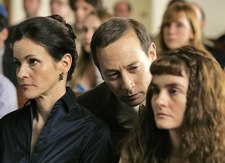
Based on a true story which director Marco Amenta explored 12 years ago in documentary form, The Sicilian Girl feels powered by unfocused preoccupation, rather than by a more compelling creative ambition. Something about the story of Rita Atria -- a young woman who turned against her family and the mafia culture that defined them and helped the police gather a high profile case in 1991 -- has clearly struck fellow Sicilian Amenta deeply. Fictionalizing the story might have served as an occasion to inscribe that connection more personally (something Werner Herzog achieved with Rescue Dawn, his feature revamp of Little Dieter Needs to Fly); instead the story is translated, in Amenta's first feature, into the heavy meter of gangster melodrama.
more »
While eccentric people can be found everywhere, New York is a particularly fertile environment for all sorts of odd little flowers to bloom and grow. In The Extra Man, Shari Springer Berman and Robert Pulcini's adaptation of Jonathan Ames' spry and delightful 1998 novel, Kevin Kline plays just one such flower, an elegant oddball who's awful and compelling at the same time.
more »
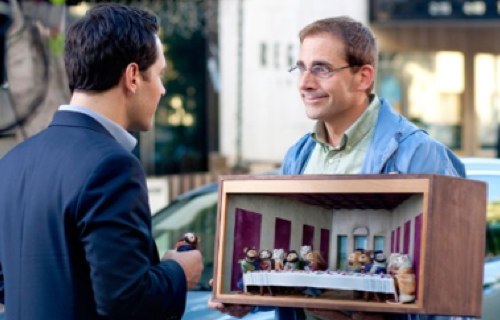
The New Yorker recently ran an extremely detailed profile of Steve Carell, written by Tad Friend, that described the complex and mysterious process of, well, trying to make stuff funny. Friend listened and watched on the set of Carell's latest, Dinner for Schmucks, as Carell, his co-star Paul Rudd, director Jay Roach and assorted other cast members built a pivotal scene layer by improvisatory layer. Friend's piece is revelatory and entertaining; in fact, reading it is a lot more fun than watching the movie.
more »
True-blue star vehicles are an increasingly rare phenomenon, in part because of a tacit, old-fashioned pact they make with audiences: The vehicle will give you an up-close and often partially clothed look at its subject, a known but not quite proven performer who will laugh, cry, and seduce for your pleasure. The vehicle will then deliver you to a destination of uplift and comfort you will subliminally associate with the subject. In return, you will deliver that subject to stardom. Who has time for the traditional route when there are so many short cuts available?
more »
Director Brigitte Berman opens Hugh Hefner: Playboy, Activist and Rebel, her hydroponically grown laurel for the Playboy kingpin's commemorative bust, with two irrelevant blowhards -- Gene Simmons and Jenny McCarthy -- outdoing themselves. Simmons, who is called back into the film whenever the level of deterministic horseshit runs low, proclaims that there is not a single man -- of any age or in any period of human history -- who would not essentially sacrifice his manhood (I believe "left nut" is the phrase) to be Hugh Hefner.
more »
There are four great faces in Aaron Schneider's debut feature Get Low. One of them belongs to a mule -- a grumpy but elegant beast with bright eyes and mischievous, snorty lips -- but a great face is a great face, and you take them anywhere you can find them.
more »
A pleasant dramatic caper that wears out its welcome, The Concert is the houseguest who sings a little too loudly and too long for his supper, tone deaf to the line between charm and imposition. As the film's fairy-tale story is stretched beyond its means, disbelief -- at first suspended with pleasure -- is restored in increments, and mild resentment sets in.
more »
Dick Cavett is resting comfortably in the hammock-shaped shadow conjoining the Venn diagrammed lives of Ron Galella and Hugh Hefner. He appears as a deadpan raconteur in both Hugh Hefner: Playboy, Activist and Rebel and Smash His Camera, two films out this week that march two more wounded 20th-centurions through documentary rehab. Cavett was of course a nexus of pop culture in the '60s and '70s, when these two hustlers were making their names on the backs of naked women (Hefner) and frightened celebrities (Galella). He has been called upon as an expert witness in what is starting to feel like a grand jury, multi-documentary effort to determine just how we got into the state we're in now.
more »
As the bipolar Latino street poet at the center of Spoken Word, Cruz Montoya (Kuno Becker) is always searching for that perfect phrase, styling his life into rhythmic prose as it passes. You feel me so far, mijo?
more »
A man in the grip of contrition, Allen (Michael Kenneth Williams) is re-vowing amends to his wife Joy (Shirley Henderson) in very tight close-up in the opening scene of Life During Wartime. "No more cocaine," he says. "No more crack. No more crack-cocaine." Joy is weepy, pliant, soothing. They are tucked into a restaurant booth, celebrating what seems like a decent stretch of functional couplehood, when a waitress comes to take their order and makes off with their stability instead.
more »
To insist on any facet of popular culture as sacred is to be hopelessly left behind, every hour on the hour. Recycling, remixing, rebooting, renaming -- no classic is safe. I am speaking, of course, of the Katrina and the Waves hit "Walking on Sunshine," a chiseled gem that is knocked off to sacrilegious effect in Ramona and Beezus, a rummage sale of a family movie derived from the work of legendary children's author Beverly Cleary.
more »
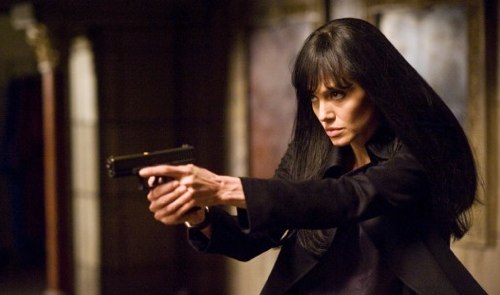
Somewhere midway through Phillip Noyce's exhilarating, over-the-top yet strangely modest action-thriller Salt, Angelina Jolie, as on-the-run CIA agent Evelyn Salt, ducks into a ladies' room to dress a nasty-looking flesh wound -- with a maxi-pad. It's an elegant and ingenious solution to a sticky problem. But then, Salt is a do-it-yourselfer, a resourceful spy who has been trained by the best. She can fashion last-minute weapons from common household items (fire-extinguisher flamethrower, anyone?) and leap off overpasses onto moving semi-trucks with the grace of a lemur (a creature that, with her wide-open, smoky-rimmed eyes, she somewhat resembles). Salt could surely, as an old perfume commercial -- borrowing straight from Peggy Lee -- used to say, bring home the bacon and fry it up in the pan. But who'd want to watch that?
more »
Farewell, a cold war drama by the French director Christian Carion, isn't just a movie set in 1981; in many ways it feels like a movie made in 1981. Unflashy and unpretentious, laid out before us in a modest, slightly grayed-out Eastern Bloc color palette, the picture moves tentatively at first: It slumps into action, rather than springing into it. But scene by scene Carion, working from a true story, builds a spy story that focuses more on the human costs of betraying one's country than on the political fallout. To put it another way, if one man's leaking of a few maps and documents can precipitate the downfall of a country, just think what it could do to his family.
more »
There's nothing so frustrating as a small movie, made by a clearly gifted filmmaker, that flies close to magic only to be sternly jerked back to earth. Kisses, by the Irish filmmaker Lance Daly, is that kind of picture, one that struggles to find its tone and ends on an uncertain, unsettling note, though one thing's for sure: Daly's missteps don't derail the performances of the two open-faced young actors who give the movie its heartbeat.
more »
Movies that draw us to the theater and then send us drifting back out with our minds full or even pleasantly scrubbed are underwritten by an urgent message: This film needed to happen. The phenomenon is impossible to quantify, but we know it when we feel it: This is working; this is right.
more »