'I'm Just a Bill' and 5 Other Videos That Will Guilt You Into Voting
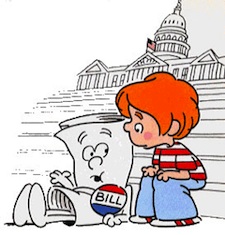 Election day: It's not just a fun song by Duran Duran spin-off group Arcadia! It's also a day where we, in theory, elect the fine citizens who will represent us in the government. Over the years, many public service announcements have been produced in order to educate us about how government works, or, to inspire us to perform our civic duty and vote. If you haven't voted yet today, perhaps one of these find videos will educate and/or guilt you into hitting your local polling station. If not, the "I'm Just A Bill" song is catchy enough that it's an enjoyable way to spend three minutes.
1.) I'm Just a Bill.
The aforementioned theme song of how a bill becomes a law from the good people at Schoolhouse Rock. The granddaddy of them all. I'm not making this up: I find this song so catchy that it's currently on my iPod. [Editor's note: Mine too]
2.) Electoral College
This one, alas, is not on my iPod. In fact, no video in the history of supposedly educational material confused me more as a child. When I was six-years-old I actually thought that the electoral college was some sort of university that, as the song states, didn't have a football team.
3.) Donny Osmond
I bet Donny Osmond wishes that he could have this one back. I mean, it's just so, so creepy. Donny's on stage, in some sort of secret police uniform, talking about defending the homeland? Whatever, Osmond, you win, I'll vote!
Pages: 1 2
 Subscribe to the new Movieline on YouTube


Comments
The National Popular Vote bill would guarantee the Presidency to the candidate who receives the most popular votes in all 50 states (and DC).
The bill preserves the Electoral College, while assuring that every vote is equal and that every voter will matter in every state in every presidential election.
Every vote, everywhere, would be politically relevant and equal in presidential elections. Elections wouldn't be about winning states. No more distorting and divisive red and blue state maps. Every vote, everywhere would be equal and counted for and directly assist the candidate for whom it was cast. Candidates would need to care about voters across the nation, not just undecided voters in a handful of swing states.
Now 2/3rds of the states and voters are ignored -- 19 of the 22 smallest and medium-small states, and big states like California, Georgia, New York, and Texas. The current winner-take-all laws (i.e., awarding all of a state's electoral votes to the candidate who receives the most popular votes in each state) used by 48 of the 50 states, and not mentioned, much less endorsed, in the Constitution, ensure that the candidates do not reach out to all of the states and their voters. Candidates have no reason to poll, visit, advertise, organize, campaign, or care about the voter concerns in the dozens of states where they are safely ahead or hopelessly behind. Voter turnout in the "battleground" states has been 67%, while turnout in the "spectator" states was 61%. Policies important to the citizens of "flyover' states are not as highly prioritized as policies important to "battleground' states when it comes to governing.
The bill would take effect only when enacted, in identical form, by states possessing a majority of the electoral votes--that is, enough electoral votes to elect a President (270 of 538). When the bill comes into effect, all the electoral votes from those states would be awarded to the presidential candidate who receives the most popular votes in all 50 states (and DC).
The bill uses the power given to each state by the Founding Fathers in the Constitution to change how they award their electoral votes for president.
The bill has been endorsed or voted for by 1,922 state legislators (in 50 states) who have sponsored and/or cast recorded votes in favor of the bill.
In Gallup polls since 1944, only about 20% of the public has supported the current system of awarding all of a state's electoral votes to the presidential candidate who receives the most votes in each separate state (with about 70% opposed and about 10% undecided). The recent Washington Post, Kaiser Family Foundation, and Harvard University poll shows 72% support for direct nationwide election of the President. Support for a national popular vote is strong in virtually every state, partisan, and demographic group surveyed in recent polls in closely divided battleground states: Colorado-- 68%, Iowa --75%, Michigan-- 73%, Missouri-- 70%, New Hampshire-- 69%, Nevada-- 72%, New Mexico-- 76%, North Carolina-- 74%, Ohio-- 70%, Pennsylvania -- 78%, Virginia -- 74%, and Wisconsin -- 71%; in smaller states (3 to 5 electoral votes): Alaska -- 70%, DC -- 76%, Delaware --75%, Maine -- 77%, Nebraska -- 74%, New Hampshire --69%, Nevada -- 72%, New Mexico -- 76%, Rhode Island -- 74%, and Vermont -- 75%; in Southern and border states: Arkansas --80%, Kentucky -- 80%, Mississippi --77%, Missouri -- 70%, North Carolina -- 74%, and Virginia -- 74%; and in other states polled: California -- 70%, Connecticut -- 74% , Massachusetts -- 73%, Minnesota -- 75%, New York -- 79%, Washington -- 77%, and West Virginia- 81%.
The National Popular Vote bill has passed 31 state legislative chambers, in 21 small, medium-small, medium, and large states, including one house in Arkansas (6), Connecticut (7), Delaware (3), The District of Columbia (3), Maine (4), Michigan (17), Nevada (5), New Mexico (5), New York (31), North Carolina (15), and Oregon (7), and both houses in California (55), Colorado (9), Hawaii (4), Illinois (21), New Jersey (15), Maryland (10), Massachusetts (12), Rhode Island (4), Vermont (3), and Washington (11). The bill has been enacted by the District of Columbia, Hawaii, Illinois, New Jersey, Maryland, Massachusetts, and Washington. These seven states possess 76 electoral votes -- 28% of the 270 necessary to bring the law into effect.
See NationalPopularVote.com