'Trust Me, I'm in Advertising': Mad Men Recapped
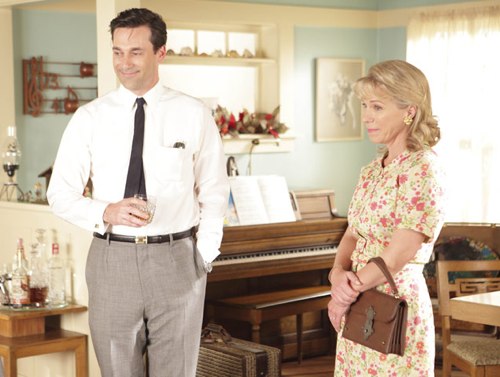
At least they weren't before Sunday, when Patty hilariously left Stephanie behind at Anna's so they and Don (who, it should be noted, is now in Dick Whitman mode, which basically means sad middle-class Midwestern white-dude mode) could go out for beer and abalone. "I have a car," he says when the mother asks aloud how her daughter will get home. Of course he does. Anyway, off they go: Stephanie jousts philosophically with Don about the more lurid tenets of advertising, soon slinking off to dance so Anna and Don can have their long-awaited, hushed-tone Big Serious Conversation about his break-up with Betty. He was relieved to have his identity burden lifted, but, exposing the Whitman/Draper duality at its passive-aggressive finest, confesses, "I could tell the minute she saw who I really was, she never wanted to look at me again."
"I'm sorry she broke your heart," Anna says.
"I had it coming," Don says. So to summarize, Betty is a class-conscious WASP bitch who looked down on her husband not because he, well, lied and cheated and connived for years, but rather because he was a poor son of a dead prostitute who also lied and cheated and connived for years. Because that's what poor sons of a dead prostitutes... do? Except: He admits he deserved it, which makes Dick Whitman either the kind of false-modest pig Don Draper would spit on or the kind of self-loathing coward that Don -- not Dick -- is supposed to be.
In other words, Anna restores Dick's faith in himself and others -- the faith that even in doing the wrong thing, the goodness and rightness of others will absolve you. Betty represents the opposite dynamic, the concept that Dick's sins cannot be absolved as long as they have been tied to the identity of a dead man. And yet this comes down as a judgment against Betty; she stands in statuesque contrast to Anna's good, pure, humane decency, even if you only get to pay her biennial visits at most. (Just take Weiner's word for it, will you?) It's kind of grossly unfair. At the very least, it doesn't reassure you that you've made the best three-year investment in Don's home life.
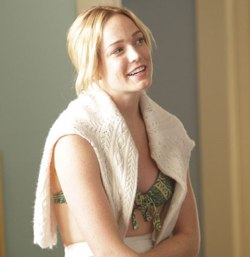 Anyway, Anna's also dying. This is the word straight from Stephanie, who shatters Don's seduction strategy with the news that Anna has terminal cancer. It has spread to her bones (hence the cast and the apparent new affinity for weed), and she doesn't have long to live -- oh, and nobody has bothered to tell Anna. The decision appalls Don, who puts on his black belt in morality and barks for answers. "Some quacks in Pedro?" he says, wanting to know who would dare hide such critical truth from an ailing woman -- ahem -- and what Stephanie and her mother are going to do about it. Good luck with that! The next day, Don does some cathartic grief-painting in the living room and confronts Patty, who persuades him to keep his mouth shut: "You're just a man in a room with a checkbook." Burn.
And so he does -- but not without the customary long face and quivering chin, neither of which signal to Anna the slightest clue that something new is preoccupying. This to a woman who purred not long before, "I know everything about you, and I still love you." Their secrets have not only proven themselves to be inbred, they've begun cannibalizing themselves as well. Off he goes with a promise to return next Easter with the kids. She'll die before then. Whatever -- we've finally killed off the California branch of Don Draper's family tree, which is really all that matters. It only took two idiot women and a towering, moist-eyed oaf to do it. What, James Franco wasn't available for a homicidal guest appearance?
Moving on, but much further on, alas: Don isn't in much of a party mood (at least not for Acapulco), so he jets back to New York for some holiday office time. There he finds Lane, also brooding and alone, thankful for the company and willing to prove it by popping a gift bottle of whiskey from his alcoholic father and sharing it with Don. The booze lubricates their bonding time, which extends to a grindhouse Godzilla screening. "You know what's going on here?" Don asks him. "Handjobs!", followed by Lane's mock-Japanese rebuke of a shushing theatergoer. See?! Lane's all right after all! Funny! And why wouldn't two frequent sparring partners who were at each others' throats as recently as Thanksgiving get drunk and go to the movies on New Year's?
And why wouldn't they follow it up with dinner together, with Lane confessing his gloomy marriage outlook following his wife's escape back to London. Don won't advise him on the matter, but he will do an even more magnanimous deed: Call up slappy hooker Candace's less-slappy colleague Jean, because if there's anything Lane could use right now, it's a good, $25 roll in the hay -- after, that is, a demonstration of T-bone steak worn squarely over the zipper of one's tailored trousers. Please. Freddy Rumsen could wet his pants 15 times before he ever achieved the indecorous low of meat in the groin. I just didn't believe it.
But that's the way the season's going, folks. Forget the ad trade, forget the sexual tension, forget the family dynamics, forget the chance that someone like Harry Crane might drop by for more than a few lines to establish other characters' angst and pathologies, forget that the only reason Don interested us at all in the first place is the compounding of lives in the city, in the suburbs, in the future, in the past. Forget the gradual expansion of characters over weeks and months of smoldering arcs (where was Bethany from the season premiere? What happened to her and Don's New Year's date?). Forget vaguely realistic motivations and conflicts; aside from Lane's flower orders getting mixed up and the Joan meltdown that ensues, nothing here has anything to do with the heightened, mildly surreal office politics that have helped sustain Mad Men luster three seasons. Is this progress?
Bert Cooper wasn't present -- not was he even acknowledged -- at the partners' first meeting of 1965. It's no coincidence. If I could tune this crap out myself, I'd probably do the exact same thing.
Pages: 1 2
 Subscribe to the new Movieline on YouTube


Comments
I didn't mind this episode so much -- well, except for Anna's annoying fake earnestness and earth-motherishness and the interminable Don-painting-the-wall scene -- but this review is really spot on. This season seems somehow more robust than last season but really all over the place.
I'm pretty sure Bethany said that Don could call her after New Year's if he wanted to go out again. She said if he really liked her the interest would "keep" until after New Year's.
Well............. you're pretty blunt about it, but you're right. Mad Men doesn't seem to be about the things that made me like it in the first place.
My stomach started to hurt when Stephanie came in - thank GOD she turned him down. He's like a rabbit.
I'm not sure I even like Peggy anymore and things are getting too wierd.
I had just watched a two hour Criminal Minds rerun about a whacko who killed 89 people and fed them to his pigs, and this didn't exactly bring me out of that dark place.
"in perhaps the most tender exchange we’ve ever seen between them "
Really? I felt like it was extremely uncomfortable because she doesn't even trust old shakey hands to stitch up her finger, and painful because she wasn't crying at the joke's punchline or any kind of pain she was feeling from the wound.
I think it's unfair to say Joan's arc felt forced. Haven't you ever had a series of days or a week where you just feel like everything is going absolutely the wrong way. Is it so inconceivable that a character on a show could experience this?
Even The Sopranos kind of wandered in it's mid-run, so I guess it's kind of expected. There is SO much material they could be covering that they are ignoring -- the new firm, the difficulties of being a start-up, new roles for Peggy and Joan. Instead, we are off wandering these rabbit trails -- oh, look, Don's hot neighbor, ho ho, Don boinked his secretary, by the way, Sally Draper is crazy, oh Henry Francis's mother is tart-tongued rich gal. I thought the original characters were intersting enough to follow around, without all these other ancillary plot lines. Matt! Come back to us! Rubicon is kicking your butt!
The shark, it's been jumped.
His admission that he "can't fix anything else, but I can fix this" was the farthest we've ever seen him go to reassure her in a way that was actually reassuring. In virtually every other instance he's offered stuff like, "I joined the Army!" or that whole ridiculous attempt to split the difference in their debate over where his boss should sit at the dinner party. The fact that he actually achieved something approaching -- if not achieving -- sincerity and honesty felt like a milestone.
And sure, I have that week all the time! Joan is certainly entitled, but: Not everything did go wrong for her. Very specific things went wrong, including her OB-GYN visit, her two encounters with Lane (which his arc seemed to depend on much more than hers, anyway), and the cut hand -- so we could get a more complex idea of Greg, not a more complex idea of Joan. We had to know right now before he goes away what she might be losing. It was just all machination and scamming, which I guess Mad Men has always been, but I just can't buy it all on this grand scale.
Wow, let's get some hits for Movieline by being needlessly contrarian! "Everyone else loves Mad Men. How do we stand out from the pack?" Your bitter, overly sarcastic snipe at this season is like the dress Joan imagines that Peggy set out to buy for New Years': it's meant to stand out from an increasingly crowded arena of blogger/recappers, but in the end it's just loud, cheap and ugly, screaming "look at me!" This recap was like reading the journal of a petulant 14 year old writing about how much he HATES his parents. We get it. You didn't love this episode, but spare us your cockamamie justifications and your watered down, miss-the-mark insights. (How about, rather than Anna Draper being clueless about her cancer, the idea that she knew her days were numbered and she was closing up shop as stoically and bravely as possible?)
Thank you!
Reading this review I really couldn't understand how the writer could honestly feel that this season is any different from seasons two or three. It just seemed like complaining for the sake of complaining. Is Mad Men perfect? No. But it has not fundamentally changed this season. If you didn't like this episode then you also shouldn't have liked almost anything last year and much of season two either. If that's the case, why are you doing this for a living?
Is Mad Men perfect? No. But it has not fundamentally changed this season.
Come on. Sterling Cooper doesn't even exist in the same physical or political space any more; there are twice as many partners, and they're barely keeping their lights on. Entire arcs from the first three seasons -- Ken, Paul, Sal, Duck -- ceased to exist.
Also: Don and Betty are divorced. Betty is remarried.
I'm not saying these necessarily have to be bad things in the overall flow of the show. But for me personally -- one guy whose been a devoted fan since the beginning -- If there are any more fundamental changes than these, I don't know what they could be.
I have an issue with "Ken, Paul, Sal Duck--ceased to exist..." Ken is NOT off the show; apparently he'll be back next week. Duck has already shown himself to be a character they're not finished with and I'm thinking it's pretty likely that at some point we're going to see Paul and Sal again...afterall, it took a season and a half before we got a return of our favorite zipper playing drunk. I like the way that characters in this show act like people in real life...EVERYONE has people in their lives they only run across every few weeks, or months or even years; it's refreshingly believable behaviour for a television drama. I hate it when shows feature the SAME core group of people together for YEARS because tv show runners are afraid to break up the core dynamic of a show (I'm looking at YOU, The Office...) It's fake, unbelivable and boring.
Yes the circumstances of the characters have changed. But the fundamental questions the show raises -- how to assign value to objects in order to make people think they want them; why people fool themselves into thinking they want something because they think it is expected of them; what happens when those assigned values, inevitably, decrease over time; and most importantly the vast difference between what people project of themselves and their internal realities -- these things are the same.
Changing the trappings: where they live, where they work, who they work with -- just shows that time has passed.
In my mind, it would get boring if the settings and characters didn't change over the five years internal to the show. I really don't think that Don and Betty's marriage could have possibly lasted any longer. And the idea that they started a new company and ditched some old favorites along the way is completely realistic to me within the confines of the show.
If no characters ever left the show, if the relationships between the characters never changed, then the suspension of the show would be unbelievable. It would be a cartoon of itself. We worry about Don and Peggy and the fate of the new company precisely because we know that things can change drastically. If everything was reset at the end of every season it would be dull as dishwater.
Yes! It is much more true to life to have the characters and the settings change over time. Five years is a long time. Does everyone who worked at your office five years ago still work there? Do you still work there? Are your relationships with your friends, family and co-workers the same? Of course not. It is so refreshing to see a show where time actually passes and they're not afraid to make big changes in the setting, while still maintaining the same fundamental tone and ideas presented in the pilot.
Dear S.T.,
I find myself torn between really liking your writing and completely disagreeing with what you have to say. I think "Mad Men" is better than ever, but I'm one of those people that like seeing a series burn its ships once in a while and go into uncharted territory without a safety net (I'm so passionate I've had to use THREE cliches in one sentence).
I won't deny that there's something very comforting about the old Sterling Cooper, but I'm happy to move forward - especially because it would be dishonest for it to be business at usual for all these characters during the middle of the 1960s.
I'm also happy to see less Betty Draper and no Depression-era flashbacks. It's good to get the sense that California Dick Whitman is also being wrapped up because quite frankly, I think finding out who Don Draper used to isn't nearly as interesting as discovering who he will be in the future.
The Future, Conan? THE FUTURE.
@Strangeways/@Nathalie: I'm with you both to a point. Change is most certainly welcome, but I don't believe much of the change I've seen since the premiere. I don't believe the writing, I don't believe the personalities, and I don't believe the scenarios. For reasons I went on and on about above, last night was a milestone for me in the sense that nothing made sense -- even in the heightened context of this show. Stephanie, for example, was not an actual character. She was a device to set the time, to ensnare Don/Dick (because apparently we didn't get his weakened sexual command after three or four times in the first episodes), and to pass along the cancer news. And then I didn't believe his reaction, or that no one would tell Anna because of her -- they wouldn't tell Anna because it would then remove Weiner's dramatic need to have Dick had to look into her eyes and lie/hide again. It was so calculated and telegraphed in ways I'd never seen on Mad Men before, and that alone is change I can't go for.
@Gideon: Thanks for the compliments! And actually we totally agree on the California end. "Forward ho," I say. But I'm also saying, "What's the rush?"