'Trust Me, I'm in Advertising': Mad Men Recapped
Sunday's episode of Mad Men made for an unlikely grand finale to Shark Week, seeing as Matthew Weiner and Co. provided one of the sturdiest, stuntiest ramps possible for Don Draper to jump over the bloodthirsty creatures swimming below. If only he'd stuck the landing instead of tumbling to a broken, maudlin heap on the other side. It's almost enough to make a spectator ask for his money back. Let's revisit the horror.
Every week I feel myself giving this show more and more of the benefit of the doubt, and more and more that benefit is betrayed with fearsome regularity. So far in season four we've had slappy hookers, creepy young vandals (who are apparently the only way to get Sally written into an episode anymore), ham brawls, one-legged journalists, and of course the constant reminders of Don's fading sexual power. The imperative to keep Mad Men fresh has collided with the impulse to reinvent its chemistry -- postmodern soap opera beneath a shroud of cable-TV gravitas. It's an odd irony considering Don's own advice to a fraught client last season: "If you don't like what's being said, change the conversation." What about the obverse? What if you're the best show on television, and all that's being said reinforces that supremacy? Do you still need to change the conversation? Just to keep things honest, perhaps?
Maybe so. Weiner sort of attempted to ease us into the transition, taking us along to the gynecologist's office with Joan, who is just checking up to making sure that when she's ready to make rapey, shaky-handed, accordion-foisting, narcissistic little Gregs, her womb will a welcoming place for his seed as opposed to the depleted site of not one but two abortions. (Oooh! So edgy, Weiner, edgy.) Even her doctor is surprised by the news of the second procedure, which of course prompts the question at home: Was it Roger's? Was it Greg's from the office rape?
We'll probably never know, because this whole arc is building to the broader issue of Joan losing her legendary control. Can't a girl offer fried chicken to her boss ("A breast? A thigh?") without failing to coax a few days of babymaking time off after New Year's? Can't she make alternative arrangements with Greg without a hair-raising (and voice-raising, in what might be a first for Joan) reminder that he's going to Vietnam? Can't she stage a luau-themed party for him without slicing her hand open attempting to make orange juice? Can't she receive stitches from him -- in perhaps the most tender exchange we've ever seen between them -- without crying to the punchline of his jokes? And can't she receive Lane's dozen make-up roses without their accompanying message being switched with one intended for his estranged wife in London? (At least she did fire the offending secretary; take your wins where you can get them.)
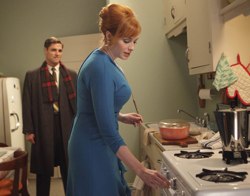 The thing about all this is that we've so desperately wanted more for Joan to do -- more dynamic scenarios, more context for (and challenges to) her brass -- because we already know she's human. Yet between the blood and the tears and the temper and her potential infertility, Weiner clubs us over the the head with a vulnerability bludgeon: The Joan plot unfolds like the work of a bookkeeper trying to get one last open transaction closed before the end of the year. Other characters who've had three seasons to sketch in their character gradations earn your sympathy, your anger, your anguish. You feel all these things on Joan's behalf, but not necessarily because they're earned. At best, they're forced. At worst, they're stolen.
At least she didn't have to go all the way to California to bottom out. That was Don's misfortune -- and ours. Let me see if I have this straight: En route to Acapulco for New Year's, Don planned a stopover in Southern California to visit Anna Draper. Arriving there to find her leg busted and in a cast, he elicits a vague explanation about fried eggs and bare feet that we all know is BS (and yet Don, the world's reigning emperor of BS, doesn't pick up on it). Enter Anna's sister Patty and niece Stephanie -- of course a niece, all grown up. "Last time I saw you, you didn't have front teeth," Don drools, admiring the nubile flesh of her midriff and legs while absorbing her Berkeley-bred political zing. "I agree with what they're doing," Stephanie says of her more activist peers, "but somebody's got to go to class." Deferential and defiant! A true modern woman! Except we have one of those already: Her name is Peggy Olson, and I was missing her terribly at this point.
Obviously the introduction of a putative Don Draper lust object never goes well. But from Rachel Menken to Suzanne Farrell, they've all sustained their appeal through a certain narrative classiness that Don refuses to show them himself. They're multidimensionalized women whose broader influence in the Mad Men cosmos defies their characters' more rigid social roles and expectations. Even to the extent they're left behind or used (e.g. Don's stewardess conquest in season three's premiere), they belong there to remind us of the relationships Don takes for granted. They are generally necessary, or at the very least not embarrassing. Which is to say: These women are not merely plot points.
Pages: 1 2
 Subscribe to the new Movieline on YouTube


Comments
I didn't mind this episode so much -- well, except for Anna's annoying fake earnestness and earth-motherishness and the interminable Don-painting-the-wall scene -- but this review is really spot on. This season seems somehow more robust than last season but really all over the place.
I'm pretty sure Bethany said that Don could call her after New Year's if he wanted to go out again. She said if he really liked her the interest would "keep" until after New Year's.
Well............. you're pretty blunt about it, but you're right. Mad Men doesn't seem to be about the things that made me like it in the first place.
My stomach started to hurt when Stephanie came in - thank GOD she turned him down. He's like a rabbit.
I'm not sure I even like Peggy anymore and things are getting too wierd.
I had just watched a two hour Criminal Minds rerun about a whacko who killed 89 people and fed them to his pigs, and this didn't exactly bring me out of that dark place.
"in perhaps the most tender exchange we’ve ever seen between them "
Really? I felt like it was extremely uncomfortable because she doesn't even trust old shakey hands to stitch up her finger, and painful because she wasn't crying at the joke's punchline or any kind of pain she was feeling from the wound.
I think it's unfair to say Joan's arc felt forced. Haven't you ever had a series of days or a week where you just feel like everything is going absolutely the wrong way. Is it so inconceivable that a character on a show could experience this?
Even The Sopranos kind of wandered in it's mid-run, so I guess it's kind of expected. There is SO much material they could be covering that they are ignoring -- the new firm, the difficulties of being a start-up, new roles for Peggy and Joan. Instead, we are off wandering these rabbit trails -- oh, look, Don's hot neighbor, ho ho, Don boinked his secretary, by the way, Sally Draper is crazy, oh Henry Francis's mother is tart-tongued rich gal. I thought the original characters were intersting enough to follow around, without all these other ancillary plot lines. Matt! Come back to us! Rubicon is kicking your butt!
The shark, it's been jumped.
His admission that he "can't fix anything else, but I can fix this" was the farthest we've ever seen him go to reassure her in a way that was actually reassuring. In virtually every other instance he's offered stuff like, "I joined the Army!" or that whole ridiculous attempt to split the difference in their debate over where his boss should sit at the dinner party. The fact that he actually achieved something approaching -- if not achieving -- sincerity and honesty felt like a milestone.
And sure, I have that week all the time! Joan is certainly entitled, but: Not everything did go wrong for her. Very specific things went wrong, including her OB-GYN visit, her two encounters with Lane (which his arc seemed to depend on much more than hers, anyway), and the cut hand -- so we could get a more complex idea of Greg, not a more complex idea of Joan. We had to know right now before he goes away what she might be losing. It was just all machination and scamming, which I guess Mad Men has always been, but I just can't buy it all on this grand scale.
Wow, let's get some hits for Movieline by being needlessly contrarian! "Everyone else loves Mad Men. How do we stand out from the pack?" Your bitter, overly sarcastic snipe at this season is like the dress Joan imagines that Peggy set out to buy for New Years': it's meant to stand out from an increasingly crowded arena of blogger/recappers, but in the end it's just loud, cheap and ugly, screaming "look at me!" This recap was like reading the journal of a petulant 14 year old writing about how much he HATES his parents. We get it. You didn't love this episode, but spare us your cockamamie justifications and your watered down, miss-the-mark insights. (How about, rather than Anna Draper being clueless about her cancer, the idea that she knew her days were numbered and she was closing up shop as stoically and bravely as possible?)
Thank you!
Reading this review I really couldn't understand how the writer could honestly feel that this season is any different from seasons two or three. It just seemed like complaining for the sake of complaining. Is Mad Men perfect? No. But it has not fundamentally changed this season. If you didn't like this episode then you also shouldn't have liked almost anything last year and much of season two either. If that's the case, why are you doing this for a living?
Is Mad Men perfect? No. But it has not fundamentally changed this season.
Come on. Sterling Cooper doesn't even exist in the same physical or political space any more; there are twice as many partners, and they're barely keeping their lights on. Entire arcs from the first three seasons -- Ken, Paul, Sal, Duck -- ceased to exist.
Also: Don and Betty are divorced. Betty is remarried.
I'm not saying these necessarily have to be bad things in the overall flow of the show. But for me personally -- one guy whose been a devoted fan since the beginning -- If there are any more fundamental changes than these, I don't know what they could be.
I have an issue with "Ken, Paul, Sal Duck--ceased to exist..." Ken is NOT off the show; apparently he'll be back next week. Duck has already shown himself to be a character they're not finished with and I'm thinking it's pretty likely that at some point we're going to see Paul and Sal again...afterall, it took a season and a half before we got a return of our favorite zipper playing drunk. I like the way that characters in this show act like people in real life...EVERYONE has people in their lives they only run across every few weeks, or months or even years; it's refreshingly believable behaviour for a television drama. I hate it when shows feature the SAME core group of people together for YEARS because tv show runners are afraid to break up the core dynamic of a show (I'm looking at YOU, The Office...) It's fake, unbelivable and boring.
Yes the circumstances of the characters have changed. But the fundamental questions the show raises -- how to assign value to objects in order to make people think they want them; why people fool themselves into thinking they want something because they think it is expected of them; what happens when those assigned values, inevitably, decrease over time; and most importantly the vast difference between what people project of themselves and their internal realities -- these things are the same.
Changing the trappings: where they live, where they work, who they work with -- just shows that time has passed.
In my mind, it would get boring if the settings and characters didn't change over the five years internal to the show. I really don't think that Don and Betty's marriage could have possibly lasted any longer. And the idea that they started a new company and ditched some old favorites along the way is completely realistic to me within the confines of the show.
If no characters ever left the show, if the relationships between the characters never changed, then the suspension of the show would be unbelievable. It would be a cartoon of itself. We worry about Don and Peggy and the fate of the new company precisely because we know that things can change drastically. If everything was reset at the end of every season it would be dull as dishwater.
Yes! It is much more true to life to have the characters and the settings change over time. Five years is a long time. Does everyone who worked at your office five years ago still work there? Do you still work there? Are your relationships with your friends, family and co-workers the same? Of course not. It is so refreshing to see a show where time actually passes and they're not afraid to make big changes in the setting, while still maintaining the same fundamental tone and ideas presented in the pilot.
Dear S.T.,
I find myself torn between really liking your writing and completely disagreeing with what you have to say. I think "Mad Men" is better than ever, but I'm one of those people that like seeing a series burn its ships once in a while and go into uncharted territory without a safety net (I'm so passionate I've had to use THREE cliches in one sentence).
I won't deny that there's something very comforting about the old Sterling Cooper, but I'm happy to move forward - especially because it would be dishonest for it to be business at usual for all these characters during the middle of the 1960s.
I'm also happy to see less Betty Draper and no Depression-era flashbacks. It's good to get the sense that California Dick Whitman is also being wrapped up because quite frankly, I think finding out who Don Draper used to isn't nearly as interesting as discovering who he will be in the future.
The Future, Conan? THE FUTURE.
@Strangeways/@Nathalie: I'm with you both to a point. Change is most certainly welcome, but I don't believe much of the change I've seen since the premiere. I don't believe the writing, I don't believe the personalities, and I don't believe the scenarios. For reasons I went on and on about above, last night was a milestone for me in the sense that nothing made sense -- even in the heightened context of this show. Stephanie, for example, was not an actual character. She was a device to set the time, to ensnare Don/Dick (because apparently we didn't get his weakened sexual command after three or four times in the first episodes), and to pass along the cancer news. And then I didn't believe his reaction, or that no one would tell Anna because of her -- they wouldn't tell Anna because it would then remove Weiner's dramatic need to have Dick had to look into her eyes and lie/hide again. It was so calculated and telegraphed in ways I'd never seen on Mad Men before, and that alone is change I can't go for.
@Gideon: Thanks for the compliments! And actually we totally agree on the California end. "Forward ho," I say. But I'm also saying, "What's the rush?"