Moment of Truth: Winnebago Man's Director on Docmaking with the Angriest Man in the World
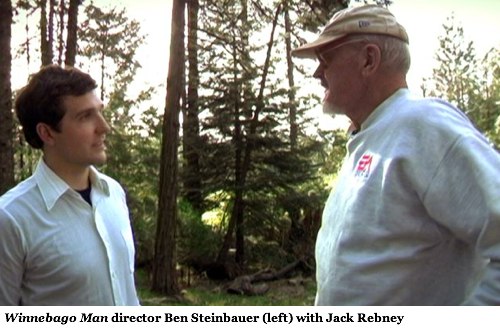
A few critics of the film have accused you of exploitation. Did his being blind -- not being able to see himself and how he's presented -- give you any apprehensions as a filmmaker?
Well, first off, I don't think Jack needs protecting. At all. He is not somebody to whom you're going to be able to do anything he doesn't consent to do, which I think is fairly obvious to people who've seen the film. I'm trying to encourage him along all kinds of different lines, and that's where we're clashing, you know? So, no. I think the fact that Jack and I are friends and became friends throughout the process of making the film -- and have remained friends afterward -- points to the fact that it's not exploitative. I've heard people accuse me of possibly being cruel or mean-spirited, and I'm really surprised, honestly, by the reading of that. I feel like somebody who watched it at home on a DVD and was in a bad mood or something might be projecting onto it, because I think it's the exact opposite. My intentions always were to find this person who I realized was somebody who could view the outtakes as potentially embarrassing and unhappy about. And what I wanted him to understand was that this was something that was a source of great joy and pleasure for a lot of people.
It's a lot more complicated than just laughing at or laughing with. There's some sort of empathy that happens when people watch the clip, and I think the proof is in the pudding. It's 20 years-plus old, and people still return to it and quote it and like it and talk about it. If it was something nasty like the Christian Bale rant or these horrible Mel Gibson recordings, people wouldn't have the same reaction. People will come up to us after the movie and say, "Jack reminds me of my grandmother, or my uncle, or my brother." They're connecting him to intimate relationships they have with other people, and they come to really empathize with him during the film. If it was nasty or just schadenfreude or something on that level, we wouldn't have the same type of response.
I'm fascinated by recluses, and Jack's withdrawal into the woods was probably even more compelling to me than his viral-video superstardom. How much did that part of his story draw you in, if at all?
It's such a fabulous, romantic American ideal, isn't it? We all read Walden in high school and are taught about this romantic notion. It's very American. Somebody from the London Times wrote a big piece for us in their Sunday paper a couple weeks ago, and I was struck by that phrase: "Jack embodies a very American type of loneliness." I thought it was so interesting, and it is such an American ideal: to get away from it all, to live in the woods, to think and write and reflect. We're raised with the idea that that's high-minded and intellectual, but nobody really does that -- at least not that I know of. I mean, J.D Salinger did that, and he's one of my favorite authors. So that's cool. The guy who wrote Bridges of Madison County did that.
I think in a way that appeals to a lot of people because we're so saturated with information constantly. Maybe that ideal is gaining popularity or is more relevant than ever. That certainly appealed to me. When I found that out, I thought, "Oh, that has to be due to him being known in this way that he's not happy about." The I came to find out it was much more complicated than that: He's very frustrated with the state of the world. Somebody who's a perfectionist, like he is, is frustrated with the indignities that we all have to suffer in our day-to-day lives. As a young documentarian, that was magical for me. And also, there's the fact that he's an old CBS News producer who became disenchanted with modern media, and yet he finds himself as one of the infamous cult figures of modern media. That tension, that clash had this inherent narrative arc to it. And coupled with the fact that he's a great character, I just thought, "Well, this is a gold mine."
It's amazing because even a guy like Thomas Pynchon -- one of the most private celebrities in the world -- voices his own YouTube book ads. We've somehow struck this perfect balance between anonymity and ubiquity.
It's a particularly modern phenomenon -- the same way viral videos are. We have been granted this ability through this modern technology where we can reach a lot of people, but we can do it anonymously. Or we can do it from a place of seclusion. We have been granted what Jack's friend Keith Gordon talks about Jack always wanting in the film: He says Jack is a dichotomy because he's always wanted to have influence and be able to address audiences but at the same time "lock the gate" and sequester himself. Isn't it interesting that we've been given the keys to do that? This film embodies not just the strange modern dilemma of being a viral-video celebrity, but kind of the modern technological position of all of us, which is that we don't need to physically interact with people to reach audiences and have fans -- or interact with lots of people.
Pages: 1 2
 Subscribe to the new Movieline on YouTube