Moment of Truth: Director Reed Cowan Explores 8: The Mormon Proposition
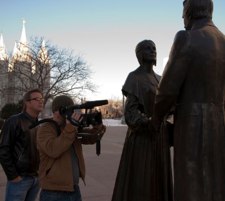 Welcome back to Moment of Truth, Movieline's spotlight on the best in nonfiction cinema. Today we hear from director Reed Cowan about 8: The Mormon Proposition, a new documentary focusing on masterminds -- and the motivations -- behind the controversial 2008 initiative banning gay marriage in California.
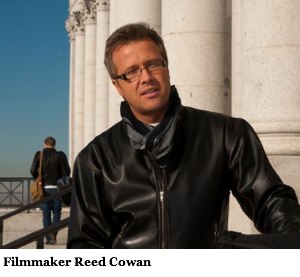
Reed Cowan didn't start out intending to lift the veil on his church. A born and bred Mormon -- with the education, two-year mission and perspective to show for it -- he had privately attempted to reckon his homosexuality with the less-than-tolerant teachings of the Church of Jesus Christ of Latter-Day Saints. But as a filmmaker and journalist for whom one treatment of the subject led to another, the development of Proposition 8 in 2008 proved the story -- and perhaps the message -- of a lifetime.
8: The Mormon Proposition is a devastating, damning study of the LDS' sordid record of dealing with its gay constituency. As if pouring millions of dollars and untold man-hours (much of it from out-of-state) into outlawing gay marriage in California weren't divisive enough, the church's history of excommunication, torture, electroshock, lobotomies (and worse, believe it or not) demonstrated its systemic interest in purging gays from its own ranks. Cowan explicitly illustrates that drive, unearthing the church records and members speaking to all manner of its philosophy -- spiritual and political -- for dealing with gay rights. From the homophobic rebukes of Utah State Sen. Chris Buttars to the ideological street duels ahead of the historic Nov. 4, 2008, vote (whose federal challenge makes continued progress this week), 8 showcases how and why one American institution got away with legislating morality.
Cowan spoke to Movieline about adjusting his original subject on the fly, the secret codes that rallied the Prop 8 base, and the one related, real-world application we can draw from Sex and the City 2.
How did you decide to make a film about Proposition 8?
Anybody who knows me I'm kind of a softie for kids -- especially young people who've been down the same roads as I have. And I didn't start out wanting to make a film about Proposition 8. I became aware a few years ago that Utah has the highest rate of not only teen suicide in the country, but also the highest rate of teen homelessness in the United States. And when surveyed, some 80 to 90 percent of those kids say they were kicked out of their homes after coming out. So we were in production on that documentary around the same time that Prop 8 was percolating. It was becoming evident that the Mormon Church had a pretty big hand in it -- we just weren't sure how extensive. So we backed off that angle when we thought, "The homelessness and the suicide we know about is the symptom of a greater problem." And what's the greatest manifestation of this problem? It's Proposition 8, the problem being bigotry spoken from the pulpit -- legislating against marginalized people from the pulpit. So that's where we started.
Yet some of the subjects in your film appear to have seen this coming. What were your thoughts as you realized the magnitude and scope of their story -- which was now your own?
First of all, a little background on me: I was schooled in the Mormon Parochial Seminary from seventh grade to 12th grade. I was schooled in the shadows of Brigham Young University at the Missionary Training Center, and then I served a two-year, door-to-door evangelical mission for the Mormon Church. So I saw what was going on relative to the political action. They were becoming something that I wasn't aware that they were.
Really? You never saw or sensed this side of the church as you grew up?
No. Honestly, every year -- and they still do this -- they read from the pulpit a letter from the first presidency of the church. They're like the grand poobah of the church. And it's spoken from the pulpit that our church does not advocates taking sides. Republican, Democrat. As a church, we remain neutral. So you hear that statement every year, and you think, "That's just how it is!" But when it became evident that they had put a call out to their members in California... On it's face, there were things that were clear to everybody. And then were thing that needed to be dug up. But they were using their Mormon-owned NBC affiliate in Salt Lake City to tell Utah Mormons to call their California relatives to get involved. And it looked like more than just a nudge to get involved. It was bigger than that. And I always say that journalists come into the Utah and they don't know what questions to ask because they weren't raised in the faith. I know the right questions to ask. And so when I, having been through the Mormon Temple -- where there's a code language used, where there are secret handshakes in the Temple, where there are secret ceremonies that go on there -- when I heard the code language used there in that call, I knew this was big.
 This is the thing about using your "means and time," right?
Exactly. In the Mormon secret ceremony, you're warned -- in fact you're taught by an actor who plays Satan himself -- that God will not be mocked. You will either abide by what you are committing to in this Temple or you will go to hell, and so will your entire family chain, so to speak. I heard this trigger language -- the "means and time" -- and I knew this was a holy war.
I wasn't sure you made the explicit connection between Mormons wanting gay marriage outlawed for consistency's sake: If they couldn't have polygamy, then gays couldn't have marriage. Is that an accurate read?
Well, the Mormons still believe in polygamy in the afterlife. So they still very much advocates for it in their rooms and their quiet [privacy]. When you peel back the root of it, they still believe that a man will become a God, have many wives, and populate a planet. The Mormon phrase is, "As man is, God once was. And as God is, man may become." The only utility in drawing that parallel was to say that, "Look, Mormons have been here too. They've practiced alternative marriage. And they of all people should be more sympathetic to the struggle." I don't know if you saw Sex and the City 2 -- or 3 or 4 or 5 or whatever they're on now -- but Carrie makes the point in the beginning: "Every relationship has the right to define itself." Mormons have the right to define their own relationships. Polygamy was frowned on by the general public -- and they were persecuted for it. Gay people have the right to define their own relationships as well. And Mormons of all people should be supportive of that rather than wage spiritual war on it.
Pages: 1 2
 Subscribe to the new Movieline on YouTube


Comments
Oh wow, that should prove to be interesting.
Lou
http://www.feds-logging.at.tc
I love this. "I don’t know if you saw Sex and the City 2 — or 3 or 4 or 5 or whatever they’re on now — but Carrie makes the point in the beginning: “Every relationship has the right to define itself.”" Can't keep his Sex in the City movies straight, but he can quote lines. Nice.
This dude is just trying to set all of the blame in one place. Is he going to do an expose on all of the other churches that donated hundreds of thousands of dollars each? What about the Catholics? What about the non-religious people who oppose gay marriage? These individuals and organization formed somewhat of a coalition. Why then must Prop 8 be attributed entirely to the Mormons? That is not giving credit to the countless others' efforts (and their hard-earned money) in defending what they feel to be right.
He knows a lot about one thing: Mormons. This expose does more to show how narrow his view on the issue really is. I am fine with free speech, but not when it is done in such a damning way. He fails to widen the perspective, which demonstrates how narrowly like-minded he is. The fact that he spared no detail about how truly noble the young gay man who procured the documents from the archives to illuminate public issues, yet went into detail about Temple ceremonies in an interview shows how distorted this guy's thinking is. Maybe he should take a cue from the brave young gay man who made this attack possible and let Mormons worship their God in the way they see fit.
Anyone who watches this film should really look into the hardships that Mormons had to endure from fellow Americans, as well as the American government. Researching Mormon history from a human rights perspective shows that the gay movement has a long way to go before it can be remotely compared.
I give this proud gay man points for effort. This said, his pride is what makes him blind to the consideration of the points aforementioned.
Thanks for the fantastic blog. I look forward to checking back in.