I do a lot of interviews. So when looking back on my favorite stories of 2010, sure, I live blogged seven Harry Potter movies over the course of 36 hours and, yes, I somehow had the time to watch five seasons of Lost in three weeks, but, interviews -- indeed, people -- are what I remember the most.
Not just any interview or interview subject, though; most of the interview settings actor-directors are thrust into aren't exactly conducive to, well, anybody. The scene at your local press junket is similar to that of a third-world sweat shop only with more pastries, or maybe a neverending mall queue of journalists waiting for their turns to sit with Santa. But, even in such less-than-ideal conditions (and, thankfully, not all of them are), a lot of interesting things can still take place with interesting people. Among them...
Movieline's discussion with Jesse Eisenberg was most definitely not at a junket. Having a conversation with someone at a bar, over the course of an hour, with no time limits or publicists, leads to exchanges like the following -- which also happens to be one of my favorite ideas, and one on which I really do hope Eisenberg follows through. Honestly, the best part about this section of the conversation was the combination of pride and glee on Eisenberg's face:
I had this idea, which I think I may implement: People ask to take pictures of me all of the time. This is like, in the last five years: Somebody recognizes you on the street. And I wasn't recognized five years ago. But it's occurred to me that with technology everybody takes a picture on their camera phone. So I had the idea that I'd only agree to take a picture -- because always, inevitably, you have to take a picture on somebody's little cell phone -- I thought it would be a good idea that they can take a picture on the condition that they will e-mail me the picture. And then I'll have all of these pictures. Then I can kind of like put them out as a book to show the absolute absurdity of it: Of standing there with my same dumb expression with 100 different people.
Have you started doing that yet? You really should.
No. My only concern is that if I get an e-mail address and somebody hacks into my computer. Do you know anything about computers? Is that possible?
I'm not an expert, but I think if you just set up a Gmail account specifically for this, like Eisenbergpictureproject at gmail or something, you should be fine.
Right! Right. That's what I need to do. I'll do it tonight.
I wouldn't give out your actual e-mail address.
No, no, I'm not going to do that. But that's totally safe?
I think so?
Could people hack in or send me viruses?
I guess they could, but Gmail is pretty good about weeding those out.
OK, Gmail. I need to get a Gmail account. This is going to be a great idea.
This is a fantastic idea.
[Laughs] Yeah.
The only thing, how do you get people to follow through on that? Then again, I bet they'd be happy to do it: "Hey, I met Jesse Eisenberg, and now he wants me to e-mail him a photo of us."
I think they would be. I think if the experience is at all exciting for them -- "Oh, I ran into someone I saw in a movie on the street..." -- they'd want that experience to continue, if that means sending somebody a picture.
They would want the story to continue, "He even gave me his email address!"
"Wait, his e-mail is EisenbergPictures@gmail?" [Laughs]
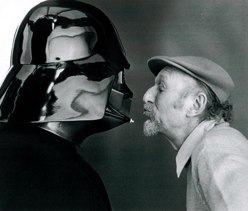
I never hesitate to mention that my favorite movie of all time is The Empire Strikes Back. So, for the opportunity to do a series of interviews for the 30th anniversary of the film was, to say the least, quite exciting. The last interview of the series was Empire's director, Irvin Kershner. The line that got the most attention was the fact that he mentioned that, if asked, he would have directed one of the prequels, but my personal favorite part was when he revealed his favorite film of the last 10 years. Kershner passed away in November and this wound up being his last interview:
"In the last 10 years of watching films I have found that some of the foreign films I saw affected me most. One American film that stands out for me for its workmanship and artistry is Ratatouille. It was an astonishing effort in filmmaking. Ratatouille has a fine mixture of a credible love story, a sense of family and the black sheep, and a mature satire. Its animation is extraordinary in its color, cinematic compositions, and well-rounded figures. Film is a window to the real world but a lie that makes you believe the unbelievable. Ratatouille is a story that keeps its tension intact throughout its telling. The film has inner rhythm, as a film should. It has a story full of suspense, humor, and believable characters. It works on many levels for adults as well as children."

When doing an interview tied to a junket (in this case, Due Date) sometimes the most that an interviewer can hope for is that something, anything, that sets his or her conversation apart from the monotony of the interview subject's day. Todd Phillips, who started the interview by coming out swinging, at least provided the uniqueness:
Thanks for taking the time to do this.
This is for Movieline?
Yes.
This Web site's the worst, but, all right, let's do it.
Oh, no. Why do you say that?
No, honestly, I'm teasing, but you guys just hate every movie. So it's like, "Ugh, really, I have to do this and open myself up to some snarky, clever title?" You know what I mean? There are movie sites that love movies and there are movie sites that are just bitter people that just hate movies. I find Movieline to be in the latter. The tone is bizarrely hateful.
Really? I wouldn't call it hateful at all.
In print. You're right, in person I've only had great experiences with [the writers]. And I'm not even talking about my own personal things, I'm saying that when I go on that site and read about other movies, it just seems like one of those sites.

It was an innocent question, really: At the time of this interview James Cameron was promoting the re-release of Avatar which, kind of coincidentally, was going to head-to-head at the box-office with Piranha 3D. Cameron's first credit as a director was a movie called Piranha 2: The Spawning, so I thought it would be fun to ask him if he feels any nostalgia toward the Piranha franchise. His answer below caused a minor sh*t storm after the producer of Piranha 3D decided to respond with a 1,400 word manifesto:
"I tend almost never to throw other films under the bus, but [Piranha 3D] is exactly an example of what we should not be doing in 3-D. Because it just cheapens the medium and reminds you of the bad 3-D horror films from the 70s and 80s, like Friday the 13th 3-D. When movies got to the bottom of the barrel of their creativity and at the last gasp of their financial lifespan, they did a 3-D version to get the last few drops of blood out of the turnip."
This was part of a series that I was doing where I interviewed a Lost cast member each week during the recent final season. Everyone in the cast was pleasant enough, but what made Lilly stand out was how she didn't at all try to hide the fact that she was quite pleased that Lost was over. She was especially pleased that she no longer had to ask permission to, as she says, make adult decisions:
"Yeah, it's like having to ask the teacher to go to the bathroom in class. It's like, 'OK, that's the most natural thing in the world, shouldn't I just be able to go?' And that's sort of how it is on our show. There is this feeling -- not a feeling, but a literal rule -- that, in order to leave the island, we have to have permission from our elders -- from our producers. And it would be nice to be an adult and have control of my life again and make those basic decisions on my own."
6. James Franco
This marks the only time that I can remember an interview subject extending an interview at a junket because he had a few things about a subject that he wanted to say that would go well beyond our original allotted time. The question was if he felt the media was fair to him, and clearly he had been thinking about the subject:
"So, things like a picture of me sleeping in class? What am I going to do? It actually wasn't class; William Kentridge was giving a talk that I didn't need to be at. It's kind of OK with me because I think it's very hard for people. People don't want the guy from Pineapple Express to be going to Yale and getting a Ph. D. They don't like it. I think people just want to... If they can't get pictures of me drunk coming out of a club, the worst they can get of me is sleeping in a 10 p.m. lecture. OK. If they want to paint the picture of the stoner going to school, it's kind of OK with me because it actually takes a lot of pressure off. If that's the way they want to depict me, it's fine. Because my schoolwork isn't a performance. I'm going there because I'm getting so much out of it and I'm getting to work with all of my favorite writers or professors. So if that's how they want to depict it, it's not taking away from why I'm there. And it takes pressure off. So you kind of have to roll with it."
Hopkins called me about an hour early, so I wasn't quite expecting him when I answered. And I certainly wasn't expecting him to simply introduce himself as "Tony." Regardless, the movie he was promoting was the forgettable-enough Wolfman and for some reason the topic shifted to, of all things, Raiders of the Lost Ark (and why action movies today aren't quite as good). Which led to one of those weird, self-aware moments where, as it's happening, all I could think was I'm discussing Raiders of the Lost Ark with Sir Anthony Hopkins. Wait, I'm sorry, Tony Hopkins:
"Well, yeah. I don't think there's any social significance in it, but I think it's a market for kids that are so multitasked, now, that I don't think anyone thinks anymore. Raiders of the Lost Ark is a good example of the spirit that lets the story unfold. You see all the action, you see everything happen. There's moments you see this and you see that, and think this is great, and you're pulled in with Harrison Ford's adventures. Or Silence of the Lambs or something like The Shining -- when Jack Nicholson's being interviewed in the hotel, the camera doesn't move at all. It keeps you on the edge of your seat. But now, I don't know what's going on and I don't care."