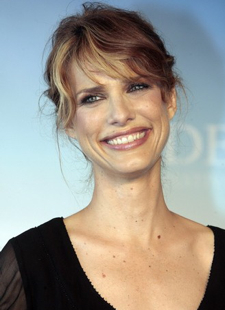
On Tuesday, Shelton phoned Movieline to discuss disproving the Seattle rockstar image, her Mad Men experience, and why low budget productions really aren't that different from high budget ones.
I just watched the entire $5 Cover: Seattle series and I am thrilled that MTV is returning to its music roots finally.
Yes! But in a new and unique way, right?
Definitely. It's a grittier, more intimate look at bands and the Seattle music community than I think the MTV audience is used to. How did you get involved in the project?
I got involved two years ago when I was at Sundance for my third feature film, Humpday. A couple days after the premiere, this guy David Gale came up to me and said that he thought I would be a good fit for a project they were producing at MTV. Really, the whole project was the brainchild of [Hustle & Flow director] Craig Brewer who is from Memphis and had all of these musician friends with interesting lives. It was his idea to create a narrative piece where they were playing themselves and it was a smart way to organically get music back into the landscape of MTV that had drifted away. So Craig made $5 Cover: Memphis for MTV and the network was looking for filmmakers from other cities.
Were you hesitant to do a web series?
I was at first and I wasn't sure that my aesthetic was something that MTV would embrace but David thought I'd be a good fit because I had done some music videos for local bands, and also because Craig had used a lot of improvisation for the Memphis series and that is what I had done for Humpday.
What finally convinced you?
The more I talked to David, the more comfortable I felt because he gave me complete creative control and I was allowed to use an all local crew. I basically hired all of my friends. He let me pick the bands and develop the series like a documentary with a really intensive development and interview process.
What were you looking for when you started interviewing bands?
I wanted to get a diverse population of bands since I could not get every flavor of the scene. I wanted to have, at least within my sampling, some diversity in genre, music, personality, gender and skin color.
Even though there was a lot of diversity, it was amazing how interconnected the bands were. You even created a flow chart to signify how certain bands were related to other bands, whether it be through family, friendship or romance.
Right, I wanted the bands to be genuinely, organically connected to each other in real life through friendship or side project or fans of each other. So one band kind of led me to the next.
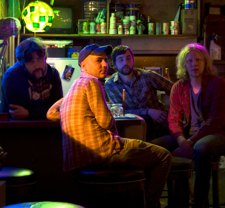
[Laughs] I would say I was trying to update, more than anything, people's perceptions of the Seattle music scene. I did a lot of traveling for Humpday to European cities and people there would ask me where I was from. When I'd say "Seattle," they'd always know two things about the city: Starbucks and Nirvana. Coffee and grunge. So it's kind of like the city is stuck in amber and I was excited to hit the reset button because there is so much fresh, dynamic stuff that is happening here that is well beyond grunge. It's funny you use the word "disprove" though because I wasn't drawn to the stories during casting as much as I was the people that seemed to be the antithesis of a rock star.
How so?
Well, I really, really relished retelling one story in particular from Jason Dodson of the Maldives and Kevin Murphy, the lead singer of the Moondoggies, who are really good buddies. They told me this story of this crazy, epic night when they rescued a drunk girl who was too drunk to remember where she lived. They tried to send her home in a cab but she was beyond knowing what was going on so they took her home and they had this funny little weekend adventure basically adopting and taking care of her. It was such a sweet story and I thought it beautifully illustrated the character of these guys and how they are just not what you think of when you think of rock stars.
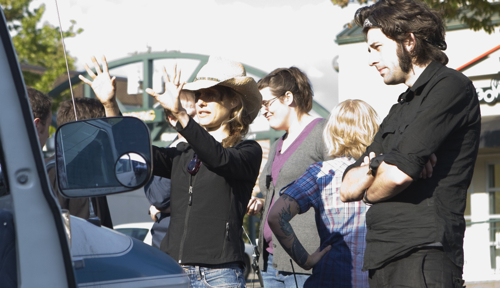
Each episode tells an eight-minute story that is based on real life events in that band's life. How did you go about figuring out which stories you wanted to tell?
I approached it like a feature film in chapters because all told, it is about 80 minutes. I kind of took it on as a project like Short Cuts, where all of these different characters' lives were thread to each other in some way. I took a very gentle approach though because I wanted to create space where they could be themselves. I didn't want to create anything that was too contrived or too melodramatic.
Was it frustrating working with non-actors?
I was definitely excited at the prospect of working with actors again after this. [Laughs] But it was really fun and rewarding.
You obviously are very devoted to Seattle. What is your relationship with Los Angeles like these days?
I'm not one of those L.A. haters at all! You can find them in Seattle for sure. I'm dead set against moving there, but visiting is great. I lived in L.A. for two months this summer and it was lovely.
You were in L.A. for your first television project. How intimidated were you to direct an episode of Mad Men?
I was so intimidated, I can't even tell you. What was great was that I got a chance to shadow another director, Phil Abraham, and that was amazing. I don't know what I would have done if I hadn't had that opportunity. I got three and a half weeks to hang out on set and get to know the crew and become comfortable with the whole rhythm of the set. The intimidation was mostly gone after a couple of days though after realizing how wonderful and supportive everyone was.
Were you able to put aside your inner Mad Men fan during production?
Well, first of all, I am a super fan of the show. It is my favorite television series. The whole time I was there I was literally pinching myself every day. I could not believe I was there. I was so happy and I bent over backwards to try to channel Matt Weiner on set and give him exactly what he wanted. I really, really wanted him to be happy and to do right by my favorite show on television. That being said, I did snap a few little memories on my iPhone and I may have taken a matchbook from the Playboy club or something.
Did you get to cast the Bunnies?
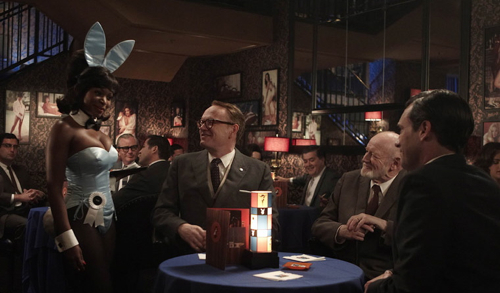
Yes! The Bunnies. That took an inordinate amount of time because first we went through a couple of rounds of casting. Then we found out that in order to get permission from Hugh Hefner to do the [Playboy club] scenes at all, we'd have to use actual Playboy Bunnies so we had to ditch our original cast list and do a whole new round of casting from Hugh's handpicked gals who came by. It was a lot of looking at girls do the bunny dip those days.
Were you pleased with Hugh's casting ability?
We were. Matt gave him very detailed specifications on the girls we needed and how they had to look "of the time" shape-wise. I think the women that we ended up populating that scene with looked perfect and absolutely amazing.
I read that of the entire Mad Men cast you really connected with Christina Hendricks. Do you have any plans to work with her again?
Not yet, no, but I would jump at the chance if there was a role that was right for her. She was delightful but they were all amazing. I was so impressed with every single one of them. They have so little time to get a scene up on its feet and that was the most difficult and most rewarding part of the entire experience for me -- trying to find the shape of the scene with those guys and make it work quickly.
So looking forward, are you anxious to return to more intimate productions or continue with higher budget projects?
Well, it was really fun to be on a sound stage and have a giant crew and work with beautiful pieces of equipment. It was very heady but ultimately, I was surprised with how similar the process is on different scales of production. For me, as a director, it all comes down to making a long list of decisions. And the pace was very similar to what I was used to. Even though the production value was a lot higher than anything I had worked on ever before and the budget was bigger, the amount of time I had to accomplish the scenes was really about the same time-wise. Ultimately, it's you and the actors and the script. Behind you, there might be a lot more people but in front of the camera, it's pretty much the same.