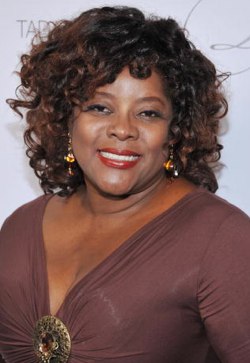
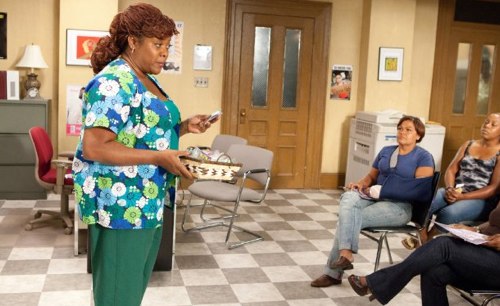
Loretta Devine stars as Juanita, a tough-talking, condom-dispensing nurse who counsels women against HIV/AIDS during the day and wonders where her elusive lover split to by night -- or most nights anyway. It's among the liveliest and full-blooded performances in Tyler Perry's film, providing the higher register of a nine-part harmony also featuring extraordinary notes by Kimberly Elise, Anika Noni Rose, Thandie Newton, Phylicia Rashad and Kerry Washington. It was Devine's first time performing Shange's poems (she missed the opportunity as a student in the '70s, when she said joining a local production would have meant leaving school), and she talked with Movieline recently about how she -- and all of her castmates -- made the most of them.
Tyler Perry wrote on his Web site that you "don't have to be a colored girl to relate to and enjoy For Colored Girls." What's your take on the audience and the potential reach for this film?
Well, I was in Waiting to Exhale, and it was a success because all kinds of women came out to see it. All kinds of women are able to identify with all the issues in it because they're very human and very universal. And I think Tyler has a big enough following that if enough people see it, then everybody's going to want to know what this is about. It encompasses everything -- every kind of relationship you could ever have is in this movie. It could have been done by an all-Spanish cast, an all-Japanese cast, you know? It's universal.
Juanita's thread deals with the play's theme of self-respect in love and sex. Yet Tyler updates this to encompass safe sex and HIV/AIDS prevention. What did you think about that interweaving -- upping the stakes, in a way?
Well, I was very happy that the character I played was a very positive one. She was working as a nurse at a clinic for women to better their education and their self-worth. In her personal life there were things that were unresolved -- things that it seemed like a woman in her position should have resolved. But it just simply showed how in relationships and love, you can't control how things go down. She was very passionate about the man that she was in love with, and she was trying to hold him. What's great about this particular piece is that all the women are not old, they're not young -- the age range is from very young to my age and older. This was an older woman who was still trying to have a love life. So the audience gets a chance to go through those emotions with her. She has to express how much she needed or wanted this man in her life, even though she knew better. It took her a great deal time to get to the point where she could walk away from this relationship.
Were there any other characters you were familiar with from the play or the script that you might have had your eye on, or who you also really appreciated as an actor?
Oh, no! I love the character I played. I got all the most exciting stuff. I got a chance to do some Ntozake Shange's most exciting poems. "Someone Almost Walked Off Wid Alla My Stuff" was one of the best poems in the entire piece for me, so I was very excited when I found I got a chance to that particular poem.
You're also on the hook for the first poem in the movie. It's kind of an early make-or-break point for whether For Colored Girls would work; did you sense any added pressure, either from Tyler or simply from yourself?
No; I didn't even know that. Everyone had their own set. You'd go to the set and work on whatever you're working on that particular day. I didn't feel the pressure of the first poem at all. The pressure came in trying to make it look like conversational -- like it isn't necessarily a poem, that you're relating to somebody on the other side of the door. I think I pulled that off, so by the time people finally met Frank, they knew who I was talking about.
We know what kind of legacy the play has in the three decades since it was introduced, but what kind of legacy do you think the film might have coming out of this era? How do they complement each other?
It's been 30 years since this play came out, and nobody even thought about it [as a film] until Tyler got it done. Well, I shouldn't say that; Tyler said Whoopi brought it to him at one point to try to do it, and there were other people who came to him about it. So the more it came back and back, he decided he had to take the challenge. Because the play is so iconic -- I mean, this is a play that's been done by girls in schools and colleges -- it has a history and a legacy of its own. I think the movie will become a classic just like Waiting to Exhale is a classic, because it's about the experiences of black women. In this country right now, we're very interested in black people because the president is black. The first lady is black. It's another way to know a race of people better.
That said, the movie critics who will help shape that legacy are predominantly white men who've always had it out for Tyler Perry. Isn't that a disadvantage in the immediate term?
You know. White men run everything. Don't start me up. [Laughs] There are people who love it. There are people who think it's not necessary. There are going to be black men who say, "I don't want to hear this any more." But this is a drama, you know? This is a piece of entertainment for people to go into and come out of and have things to talk about and reflect on their own lives and say, "Oh, God, that was me in my 20s," or, "That was a problem my girlfriend had." Because the movie resolves itself, and it teaches you that you have to find that thing inside you -- and you have to love yourself spiritually. That's the last thing that the film tells and teaches every woman: No matter what has happened to you, you have to go inside and love yourself. We're in a country that still embraces all kinds of cultures, and there's racism across the board for everybody. The people who run this country are primarily white men. So what you gonna do?
[Top photo: Dr. Billy Ingram/FilmMagic]