Sunday's episode of Mad Men made for an unlikely grand finale to Shark Week, seeing as Matthew Weiner and Co. provided one of the sturdiest, stuntiest ramps possible for Don Draper to jump over the bloodthirsty creatures swimming below. If only he'd stuck the landing instead of tumbling to a broken, maudlin heap on the other side. It's almost enough to make a spectator ask for his money back. Let's revisit the horror.
Every week I feel myself giving this show more and more of the benefit of the doubt, and more and more that benefit is betrayed with fearsome regularity. So far in season four we've had slappy hookers, creepy young vandals (who are apparently the only way to get Sally written into an episode anymore), ham brawls, one-legged journalists, and of course the constant reminders of Don's fading sexual power. The imperative to keep Mad Men fresh has collided with the impulse to reinvent its chemistry -- postmodern soap opera beneath a shroud of cable-TV gravitas. It's an odd irony considering Don's own advice to a fraught client last season: "If you don't like what's being said, change the conversation." What about the obverse? What if you're the best show on television, and all that's being said reinforces that supremacy? Do you still need to change the conversation? Just to keep things honest, perhaps?
Maybe so. Weiner sort of attempted to ease us into the transition, taking us along to the gynecologist's office with Joan, who is just checking up to making sure that when she's ready to make rapey, shaky-handed, accordion-foisting, narcissistic little Gregs, her womb will a welcoming place for his seed as opposed to the depleted site of not one but two abortions. (Oooh! So edgy, Weiner, edgy.) Even her doctor is surprised by the news of the second procedure, which of course prompts the question at home: Was it Roger's? Was it Greg's from the office rape?
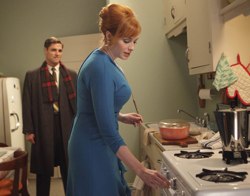
We'll probably never know, because this whole arc is building to the broader issue of Joan losing her legendary control. Can't a girl offer fried chicken to her boss ("A breast? A thigh?") without failing to coax a few days of babymaking time off after New Year's? Can't she make alternative arrangements with Greg without a hair-raising (and voice-raising, in what might be a first for Joan) reminder that he's going to Vietnam? Can't she stage a luau-themed party for him without slicing her hand open attempting to make orange juice? Can't she receive stitches from him -- in perhaps the most tender exchange we've ever seen between them -- without crying to the punchline of his jokes? And can't she receive Lane's dozen make-up roses without their accompanying message being switched with one intended for his estranged wife in London? (At least she did fire the offending secretary; take your wins where you can get them.)
At least she didn't have to go all the way to California to bottom out. That was Don's misfortune -- and ours. Let me see if I have this straight: En route to Acapulco for New Year's, Don planned a stopover in Southern California to visit Anna Draper. Arriving there to find her leg busted and in a cast, he elicits a vague explanation about fried eggs and bare feet that we all know is BS (and yet Don, the world's reigning emperor of BS, doesn't pick up on it). Enter Anna's sister Patty and niece Stephanie -- of course a niece, all grown up. "Last time I saw you, you didn't have front teeth," Don drools, admiring the nubile flesh of her midriff and legs while absorbing her Berkeley-bred political zing. "I agree with what they're doing," Stephanie says of her more activist peers, "but somebody's got to go to class." Deferential and defiant! A true modern woman! Except we have one of those already: Her name is Peggy Olson, and I was missing her terribly at this point.
Obviously the introduction of a putative Don Draper lust object never goes well. But from Rachel Menken to Suzanne Farrell, they've all sustained their appeal through a certain narrative classiness that Don refuses to show them himself. They're multidimensionalized women whose broader influence in the Mad Men cosmos defies their characters' more rigid social roles and expectations. Even to the extent they're left behind or used (e.g. Don's stewardess conquest in season three's premiere), they belong there to remind us of the relationships Don takes for granted. They are generally necessary, or at the very least not embarrassing. Which is to say: These women are not merely plot points.
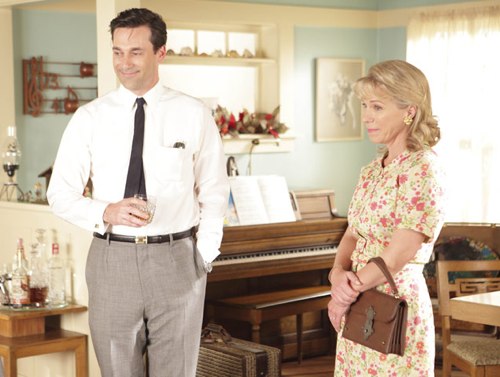
At least they weren't before Sunday, when Patty hilariously left Stephanie behind at Anna's so they and Don (who, it should be noted, is now in Dick Whitman mode, which basically means sad middle-class Midwestern white-dude mode) could go out for beer and abalone. "I have a car," he says when the mother asks aloud how her daughter will get home. Of course he does. Anyway, off they go: Stephanie jousts philosophically with Don about the more lurid tenets of advertising, soon slinking off to dance so Anna and Don can have their long-awaited, hushed-tone Big Serious Conversation about his break-up with Betty. He was relieved to have his identity burden lifted, but, exposing the Whitman/Draper duality at its passive-aggressive finest, confesses, "I could tell the minute she saw who I really was, she never wanted to look at me again."
"I'm sorry she broke your heart," Anna says.
"I had it coming," Don says. So to summarize, Betty is a class-conscious WASP bitch who looked down on her husband not because he, well, lied and cheated and connived for years, but rather because he was a poor son of a dead prostitute who also lied and cheated and connived for years. Because that's what poor sons of a dead prostitutes... do? Except: He admits he deserved it, which makes Dick Whitman either the kind of false-modest pig Don Draper would spit on or the kind of self-loathing coward that Don -- not Dick -- is supposed to be.
In other words, Anna restores Dick's faith in himself and others -- the faith that even in doing the wrong thing, the goodness and rightness of others will absolve you. Betty represents the opposite dynamic, the concept that Dick's sins cannot be absolved as long as they have been tied to the identity of a dead man. And yet this comes down as a judgment against Betty; she stands in statuesque contrast to Anna's good, pure, humane decency, even if you only get to pay her biennial visits at most. (Just take Weiner's word for it, will you?) It's kind of grossly unfair. At the very least, it doesn't reassure you that you've made the best three-year investment in Don's home life.
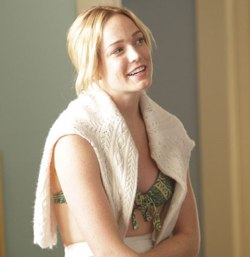
And so he does -- but not without the customary long face and quivering chin, neither of which signal to Anna the slightest clue that something new is preoccupying. This to a woman who purred not long before, "I know everything about you, and I still love you." Their secrets have not only proven themselves to be inbred, they've begun cannibalizing themselves as well. Off he goes with a promise to return next Easter with the kids. She'll die before then. Whatever -- we've finally killed off the California branch of Don Draper's family tree, which is really all that matters. It only took two idiot women and a towering, moist-eyed oaf to do it. What, James Franco wasn't available for a homicidal guest appearance?
Moving on, but much further on, alas: Don isn't in much of a party mood (at least not for Acapulco), so he jets back to New York for some holiday office time. There he finds Lane, also brooding and alone, thankful for the company and willing to prove it by popping a gift bottle of whiskey from his alcoholic father and sharing it with Don. The booze lubricates their bonding time, which extends to a grindhouse Godzilla screening. "You know what's going on here?" Don asks him. "Handjobs!", followed by Lane's mock-Japanese rebuke of a shushing theatergoer. See?! Lane's all right after all! Funny! And why wouldn't two frequent sparring partners who were at each others' throats as recently as Thanksgiving get drunk and go to the movies on New Year's?
And why wouldn't they follow it up with dinner together, with Lane confessing his gloomy marriage outlook following his wife's escape back to London. Don won't advise him on the matter, but he will do an even more magnanimous deed: Call up slappy hooker Candace's less-slappy colleague Jean, because if there's anything Lane could use right now, it's a good, $25 roll in the hay -- after, that is, a demonstration of T-bone steak worn squarely over the zipper of one's tailored trousers. Please. Freddy Rumsen could wet his pants 15 times before he ever achieved the indecorous low of meat in the groin. I just didn't believe it.
But that's the way the season's going, folks. Forget the ad trade, forget the sexual tension, forget the family dynamics, forget the chance that someone like Harry Crane might drop by for more than a few lines to establish other characters' angst and pathologies, forget that the only reason Don interested us at all in the first place is the compounding of lives in the city, in the suburbs, in the future, in the past. Forget the gradual expansion of characters over weeks and months of smoldering arcs (where was Bethany from the season premiere? What happened to her and Don's New Year's date?). Forget vaguely realistic motivations and conflicts; aside from Lane's flower orders getting mixed up and the Joan meltdown that ensues, nothing here has anything to do with the heightened, mildly surreal office politics that have helped sustain Mad Men luster three seasons. Is this progress?
Bert Cooper wasn't present -- not was he even acknowledged -- at the partners' first meeting of 1965. It's no coincidence. If I could tune this crap out myself, I'd probably do the exact same thing.