I know you're thinking this week that August on cable has got to be richer and more absorbing than August on movie screens. And you're right, beginning with giddy doses of Bunuel, Preminger and Leone...
Once Upon a Time in the West (TCM, Thursday @ 10:00 PM)
Director Sergio Leone virtually invented the Italian-made "spaghetti western," and this hot, sweaty 1969 mastodon of a movie may be its crowning exemplar. It's the most overwrought, supercool, breathtakingly lavish, preposterously lyrical western ever made. The sets are huge (farmhouses appear to have 12 or more rooms), the story absurd, the music rapturous, the faux-desert sun hot. Every aspect of it is reeling with the love for Movies. The incredible opening credits sequence alone (pictured above and featuring Jack Elam, Woody Strode, a fly, a deserted train station...) is worth the rental fee. The story involves the westward push of the railroad, a mail-order bride (Claudia Cardinale), a rogue outlaw (Jason Robards), a mysterious man-with-no-name bent on avenging his father's murder (Charles Bronson), and Henry Fonda marvelously countercast as the vilest western villain of all time. Also, a perfectly sun-scorched summer movie.
Diary of a Chambermaid (Sundance, Thursday @ 8:00 PM & 2:00 AM)
Luis Bunuel's 1964 version of Octave Mirbeau 's sardonic novel, coming 18 years after Jean Renoir's Hollywood version, is a luxurious, relaxed rip through bourgeoisie manners, but of course it's all about sex -- as in, how hilarious unsatisfied sexual obsession is to the objective viewer. Jeanne Moreau's legs, footware and maid's uniform are a constant source of agonized swooning, but she remains aloof and disdainful amid the hypocrisy, bigotry, molestation, predation and murder.
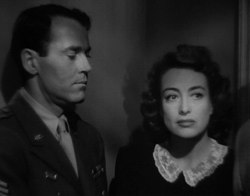
Wildly overlooked in its day and since, Otto Preminger's 1947 women's film-noir is nothing less than a secret Hollywood masterpiece. Career-woman Joan Crawford is stuck between men in a muddled and morally ambiguous postwar America, carrying on a cynical affair with married man Dana Andrews, a big shot lawyer who knows Walter Winchell (walking through, playing himself), and who irresistibly calls other men "honeybunch" and "dewdrop," and whose home life is a bitter catastrophe. Yet Preminger never pigeonholes him, nor amorous vet Henry Fonda, who may be a schizoid menace.
The Grandmother (Sundance, Monday @ 9:20 PM)
David Lynch's 1970 short was his third, made when he was still in his art-school years. It's a vital precedent to Eraserhead and Blue Velvet, and you will not find a hotter, mustier, more disconcerting 34 minutes anywhere on view this week. It's about a kid, an attic, and the grandparent he grows there.
The Birds (Thriller Max, Wednesday @ 2:15 PM)
However familiar, lionized and otherwise dismissed as a genre goof, Alfred Hitchcock's 1963 classic remains his strangest, most consciously surrealist film -- the most deeply irrational film ever made by a Hollywood studio. The nature-gone-berserk scenario is still remarkable for having no reasonable foundation, so the extraordinarily evocative set pieces -- the bird-covered jungle gym, the attack on the phone booth, the torrent of birds pouring in through the fireplace, the final world-of-perched-birds apocalypse -- suggest less an exercise in terror/suspense than a nervous dose of Hollywood Dada.
The Mission (Encore Drama, Wednesday @ 12:35 PM)
Although it was Oscar-nominated thoroughly enough, this 1986 Roland Joffe historical epic got little love from critics and audiences, but it deserves better. For one thing, it's got a majestic visual sensibility, and for another it's got Ennio Morricone's most-moving-film-score-ever. But it's also a sophisticated portrait of Age of Exploration power politics, Catholic hypocrisy and native-peoples abuse, and try and name another movie that takes on that rib roast.
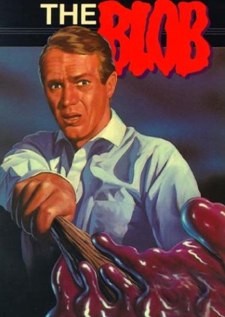
Another smokin' summer movie - in this original 1958 B-movie, an alien jelly-mold has invaded Eisenhower-era, drive-in-crazy Middle America, and only honest teen Steve McQueen (who was actually 28) can save us. There's something quintessential here, a potent feel for small towns at night when everyone's home looking toward bed except the pesky teenagers -- those kids! -- and the amused, lazy cops manning the local station.
Junior Bonner (TCM, Tuesday @ 12:15 AM)
TCM's Steve McQueen day eventually leads to this 1972 Sam Peckinpah comedy, a lazy-boned vision of American rodeo culture. Coming from an era in Hollywood moviemaking when satiric/realistic, shot-on-location delvings into off-road Yankee lifestyle was not only in fashion but politically vital, Peckinpah's meandering neo-western -- in which McQueen is a fading rodeo star and scion of a dissolving Western family of four-flushers and counterjumpers -- pegs the day and age, never sentimentalizes, and even gives supporting-perf scumbags Bill McKinney and Joe Don Baker roles with ambivalence and heart. McQueen's reticent personality and hypnotic physical grace are in perfect service, and the air of authenticity is stinging.
Distant Voices, Still Lives (IFC, Wednesday @ 10:15 AM, 4:45 PM)
This rapturously-made 1988 Brit movie put director Terence Davies on the map, as he meticulously recreates his own boyhood and life with the tyrannical psychobeast father (played by Pete Postlethwaite) who wrecked their lives and succumbed to stomach cancer in the late '40s, when Davies was 7. Experimental in its details, split in half like a diptych and saturated with songs from the era, it's one of a kind -- except for its sequel, The Long Day Closes (1992), which carries Davies's avatar through to early adolescence.
Harlan County USA (IFC, Monday @ 4:30 AM)
Barbara Kopple's Oscar-winning socialist-cinema paradigm offers an extraordinarily detailed chronicle of an intimate, forgotten American war. Documenting a 1973 Kentucky coal-miners' strike in what amounts to real time (there are no after-the-fact summaries), Kopple documents a community tale of murder, gun threats, crowd violence, poverty, corporate usury and, in the end, astonishing union solidarity. When it was released in 1976, Kopple's rather terrifying film rocked its minuscule audience and instantly became a cultural touchstone. Today with its memories of healthier early-20th-century worker networks, it also underscores the pathetic state of organized labor in the new global economy.