Welcome back to Moment of Truth, Movieline's spotlight on the best in nonfiction cinema. Today we hear from paparazzo Ron Galella and filmmaker Leon Gast about their new documentary Smash His Camera which opens Friday in limited theatrical release.
It might be the healthiest creative relationship Ron Galella has ever had: As the subject of Oscar-winner Leon Gast's latest documentary Smash His Camera, the infamous paparazzo gets to tell his side of a career-long story that includes getting punched by Marlon Brando, sainted by Andy Warhol, outfoxed by Robert Redford, and, most famously, tangling with his beloved Jackie Onassis on the streets and eventually in court. It's an entertaining, disturbing and at times cathartic portrait of how we perceive celebrity -- or at least how we perceived celebrity, now that Galella's successors have veered away from his artistic path into more aggressive, exploitative pursuits and measures.
To Gast's credit (and not surprisingly at all, really), Camera doesn't bow to Galella. His enemies have voices, and again, his legacy has more than a few long shadows drawn into sharp focus here. But its most interesting revelation is its vision of Galella as a working man -- one who loves his job, but one whose idea of glamour is far removed from the product of his labors. He makes art, tons of it, showing up to the assembly line every day, always ready to make more. Galella doesn't take pictures as much as he searches.
For what, though, is ultimately unclear. Smash His Camera reveals just enough to provoke that determination among viewers -- or least for this viewer, who took his questions straight to the sources.
Ron, how did you come to meet Leon Gast in the first place?
RG: Actually, you see, the producer, Adam Schlesinger, his father, Stuart Schlesinger, tried my case with Jackie in 1972. It was a 26-day court battle. Adam called Leon, and they approached me on the phone: "Are you interested in making this documentary?" And they came to my house; I said, "You're welcome, and we're flattered that you want to do it." He had good credentials; he's an Academy Award winner for When We Were Kings some time ago. That's how it started. It's mainly from the trial with Jackie. And of course she won in court, because she had a judge that President Kennedy appointed. I had two trials! He heard both of them. There was the one in 1972, where I got the injunction to stay more than 25 feet [away from Onassis], and then in 1982 I broke that injunction and I faced seven years in jail and a $120,000 fine. So I surrendered all three -- Jackie, John Jr. and Caroline -- from shooting them forever. The injunction still remains for Caroline. If I even take a picture, she can go to court.
What if Caroline had run for Senate, which she came close to doing in New York?
RG: I would have to get permission. That almost came about.
How can a public figure running for national office prohibit a photographer from taking her picture?
RG: She's like her mother. She likes privacy. In fact, she had a book out about privacy, and when they had her on TV, she skipped the question about me and Jackie. I think she has guilt, because she testified about one of the takes where she was riding her bike in Martha's Vineyard. She said she almost fell off her bike, which is a bunch of baloney. I think she has guilt that she did it for her mother to win the case.
Well, back to you and Leon: When you told him, "Be my guest," what did "all-access" mean? Was there anything off limits? Any topics or subjects?
RG: No. There was generally no off-limits. They shot over 50 hours of film. It's crazy. A lot of the stuff they left out was great. Like when we had the Italian government sponsor a big exhibit for the book I did, Viva Italia. The government made me a citizen. It was a big thing. Oh well.
How did you respond to the other photographers' and artists' impression of your work as seen in the film?
RG: I didn't like that guy Hoving from the Met. [Thomas Hoving, late director of the Metropolitan Musuem of Art.] He was the worst. He had 10 years at the Met, and he traveled around the world collecting paintings. I believe he was negative for two reasons: First, he doesn't believe photography is an art. Second, Jackie was on the board of the Metropolitan Museum, and he was doing her a favor when he didn't want me represented. That was out of respect to Jackie. But this makes him look like a hypocrite, because there he is when he's younger, smiling into my camera. There's a second shot that they didn't put up of him in his bow tie, smiling into my camera. So to me he's a hypocrite. And I think he's wrong: Photography is the art of today. And that's my achievement: Getting my pictures into museums. We sold a picture here yesterday of Jack Nicholson -- $1,400. Five of my pictures are at MoMA in New York.
Leon, were you a fan of Ron's before making the film?
LG: No. I grew up in New York City, so I was subjected to a barrage of anti-Ron Galella media -- radio, television, newspapers, magazines... I had this preset notion of who Ron Galella was, what he was like. I spent a couple of hours with him and was convinced after hearing his M.O. and having done a little bit of research. I read Jackie O.'s biography by Kitty Kelley, and she touches on his relationship with Jackie Onassis. His -- he's part of the book. Jackie was a control freak. Jackie loved publicity, but she wanted the publicity on her terms: "You can take my picture, Ron, when my people say it's OK to take it." I might be distorting it a little bit.
RG: [Shakes head] No.
LG: Ron operates on the premise, "I'm the artist, and I'll take your picture when I want to take your picture."
RG: The point that she made in court... See, she used to be a photographer. And My lawyer asked, "Didn't you take pictures without permission?" She said, "No, I asked permission when I took pictures." So that's why she was against me: I didn't ask permission. But if I asked permission, then I would never get my pictures the way I wanted. Spontaneous expressions only come when you don't pose for pictures.
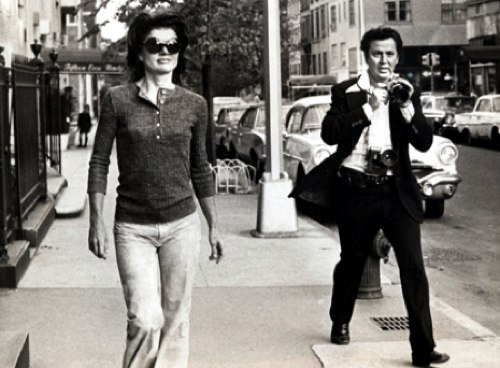
The whole time I was watching the film, I kept wondering, "Why? Why the relationship with Jackie?" Finally you address why, but have you thought any more about it yourself since that interview, on the spot?
RG: I think it's a romance between the camera and the subject. I think she loved it. Once, the only time she grabbed me, she was coming out of 21 with Ari [Onassis]. She grabbed my wrist and pinned me against the limo with her elbow: "You've been hunting me for two months now!" She was angry, but she was flattered that I was pursuing her. And I think she loved it.
LG: And we had exactly that same question. We were shooting it and editing it pretty much at the same time -- cutting, shooting, cutting, shooting. After we had a rough cut, we all asked the question: "Why? Why was he obsessed with her?" And we asked it a couple of times, and finally he did say, "I've thought about it: I didn't have a girlfriend, and she was..."
RG: My girlfriend.
LG: "...kind of my girlfriend." And that answered the question, and we hoped that enough. But you're asking if he thought it was more than that, so...
RG: Well, naturally, to me she was a great figure. A former first lady. I respected her! I put her on a pedestal by spending all this time pursuing her. When she'd go to the 21 club it might be four hours before she came out -- sometimes in 12 degree weather. So it's my passion to get these pictures, you see?
LG: He has patience!
In the film, Floyd Abrams calls you the "price tag of the First Amendment." How would you respond?
RG: To me, she was fair game just like other celebrities. In court she claims I invaded her privacy and harassed her, but that's not true. First of all, she was in public areas when I shot her: streets, the park, wherever. Airports. It was all legal property. I didn't harass her. But to win the case, she lied in court and had people lying for her. She said I jump out of bushes. I jump into bushes to get the picture, off-guard. Like the pictures of John on the bike in the park? On the pedestrian path? I hid in the bushes to get those pictures. Then she said, "Oh, it's you again." Then she ordered the agent not to let me shoot anymore, and that's when she said, "Smash his camera, Mr. Connelly!" But he didn't.
LG: Listen, Floyd Abrams is probably the most renowned First Amendment scholar in the country. But I think that Floyd thinks of freedom of the press as freedom of the "press" -- not the "press the way it was expanded to cover Ron Galella."
Finally, Ron, what do you think of your heirs? The tabloid paparazzi, the TMZ videographers and the like?
Oh. It's a sad scene. I don't like it. It's too much. They go too far. I do think they harass the stars: They get in their way, the star trips... See, the old paparazzi in Italy? They tried to create an incident to sell the pictures. That's the old-fashioned way -- to provoke. Some of these paparazzi today try to do that. They try to make an incident so they can make a saleable picture by provoking them. To me, that's unethical. I would never do such a thing. And when Brando slugged me and knocked five teeth out, I did not provoke it. He called me over! He said, "What else do you want?" I said to take off his [sun]glasses; it was nighttime in Chinatown. His answer was a punch to my jaw.