Welcome back to Moment of Truth, Movieline's spotlight on the best in nonfiction cinema. Today we hear from director Oliver Stone about his new documentary South of the Border, which opens tomorrow in limited release.
For all the political heat Oliver Stone has withstood (and will continue to withstand) over the years, no one can really call the guy a slacker. Take his latest doc South of the Border, which Stone filmed and edited during the course of making two narrative features and a 10-hour documentary he's still working on. The concept was simple enough, even while the implications were more than a little complex: Introduce the leaders of seven Latin American countries to U.S. and European audiences who, for too long, have received the wrong idea about them from the media. Does it work? That's up to you.
But the three-time Oscar-winner Stone isn't shy about his own judgments of Venezuelan president Hugo Chávez and his controversial counterparts in Bolivia (Evo Morales), Brazil (Lula da Silva), Argentina (husband/wife leaders Cristina and Néstor Kirchner), Paraguay (Fernando Lugo), Ecuador (Rafael Correa), and Cuba (Raúl Castro) -- the "New Bolivarians" whom Stone visits in a kind of whirlwind ideological road trip to prove their beneficence to their respective nations (and each other). The leaders speak of their open defiance of U.S. policy -- particularly that of the Bush Administration -- and their mutual goal of economic and political independence. Whilst visiting boyhood stomping grounds with Chávez, nibbling on coca leaves with Morales, and talking to policy experts about the Latin American situation, the filmmaker leaves little ambiguity as to where he himself stands.
I caught up this week with Stone, who was visiting New York with author and South of the Border co-writer Tariq Ali. Together, we discussed favorite films, misrepresentations (including Stone's own), elisions, and who's really doing the dirty work in Latin America.
How are you?
OS: You're from Movieline?
Yes, I am.
OS: Cool. Tariq has never been interviewed by that magazine. Ask him what his favorite movie is. [To Ali] Yeah, hey, what is your favorite movie? Some Pakistani Gone With the Wind thing?
TA: I can't think of one.
OS: Come on, come on, come on. [Snaps fingers] My Beautiful Laundrette?
TA: None of those. I don't like those movies.
OS: The Great Escape? The Dirty Dozen?
TA: [Ruminative pause] I guess The Battle of Algiers.
That's a good one. You can't go wrong with Pontecorvo.
OS: Yeah, you can't go wrong with that. I like that movie. I like Z, too.
TA: Oh, I like that, too.
OS: I feel like [Yves] Montand sometimes. In foreign hotel rooms, showing up to one more [interview], getting my face smashed in. Anyway, go ahead.
I will be nice! What drove you to return to documentary filmmaking?
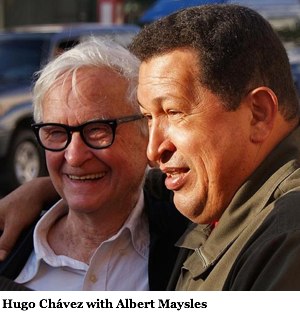
OS: Well, I started The Secret History of the United States two and a half years ago, actually. That was a big effort on my part; it's 10 hours, it's going out next year. It's a pretty intense view of the United States -- not so much secrets as it is lost history. They were once headlines, but they're forgotten. Forgotten history. But there's a new pattern; we're studying the pattern. I met with Tariq -- he's in it, we did a six-hour interview -- and in the course of making that, I had met Chávez in 2007 during the hostage crisis. Fernando [Sulichin], who's producing Secret History and produced the other three documentaries asked me to go down and do an interview with him. I went down there and loved it, and it was great. And [Chávez] said, "Don't take my word for it; go out and see my neighbors and get their opinions."
So we did, and we got what I thought was a broad-stroke view of the South American continent. Let's call it "101" -- an introduction to a great movement that's happening and has been ignored by the American and European media. Really: If you look at all these candidates, they were all democratically elected and they've all -- in some form or another -- pushed for reform in their countries. That's quite something.
Mr. Ali, how is Oliver Stone as a collaborator?
TA: Oliver is the best collaborator one could hope for. It's been really great, actually.
OS: Contrary to this reputation that... [smiling and pointing at me] you guys give me!
TA: No, there wasn't a difficult moment, honestly. It was just a joy. And I think the film shows that. It's full of hope, vibrant and it's not an ambitious film, which is what people can't get into their heads.
OS: [Laughing] I'm sorry.
TA: If you've had -- for the last 10 years -- one view dominating not just the North American but the European media, saying these guys are more or less baddies? Lula's a good guy, but Chávez is a bad guy, Morales is a bad guy, Correa is... cheeky. So we do this film, which is a mild corrective to this poison that's being spread. A tiny antidote. We don't know whether it will work or not, but that's the idea. And these guys [on the right] get worked up! "What are you doing?" We're correcting your bullsh*t, basically.
OS: I like how you put it.
OS: We play it by ear, really. It was patched together. You have to understand I'm doing a feature film called W., and I'm also trying to do Wall Street [2] while doing Secret History of the United States. And I also interviewed Castro a third time, which is coming out next year. So I've done six documentaries. This is really my fourth coming out. Meanwhile we hooked up with Mark Weisbrot from the Center For Economic and Policy Research. He was really into the policy and the statistics, and I wanted to have him aboard. I read Tariq's stuff, and I interviewed him for Secret History. Having Tariq come on with Mark is a strong combination because one is really analytical about economics -- really dry -- and Tariq has the grand historian flair to tell a story with wit and elegance. I think we needed that; otherwise it would have read like a European Union report.
TA: It was very straightforward. When I looked at some of the footage that they got, the strongest parts of that were Oliver's one-to-ones with these seven presidents.
OS: And those were arranged by Fernando and Max [Arvelaiz, Chávez advisor].
TA: So I said, "It's straightforward: You do it as a political road movie. A Hollywood director with a conscience...
OS: [Laughs]
TA: "...worries about what he's watching on the bloody media every day, hops on a plane, goes to talk to seven presidents, and you give their views -- as much as you can -- to the American people. Views that are never presented in an unmediated way on U.S. television." That's all.
OS: Honestly, what have we done wrong? I wonder what harm there is in this. Is it really going to change? Is it going to make people fall into the trap of the Communist mind?
I've always wondered that. I grew up at the end of the Cold War, and I thought, "Well, that's it." But in the last five years, people have shown they're still terrified of Communism -- of the radical left. Why?
OS: I feel like we're living through a graylist from the Bush era. Or for me it was a graylist. You know, it was clear you were either with us or against us. It was like the old days.
TA: "If you're not with us, you're with the terrorists," [Bush] said. I wrote a whole book saying we're not with you, but we're not with the terrorists either -- The Clash of Fundamentalisms. My response to Bush was that we have an independent position. We don't like Osama bin Laden!
OS: Well, there was this old argument of the '50s that the neutral bloc existed.
TA: Exactly.
OS: What's going on now is that if these countries -- these regional powers like Brazil and Venezuela -- can attain their true independence from the United States system both monetarily and militarily, then they will be the third bloc. Actually, they'll be the second bloc, unless you call terrorists the second bloc.
TA: They shouldn't be edified like that.
There's a blind spot to me in this film, at least to me, and that would be the issue of human rights. Particularly in Venezuela, where Chávez has had a judge detained, he's shut down dissenting broadcasters--
OS: Which judge are you talking about? That woman who let a guy fleece $25 million out of the currency? That was a very ugly story.
Still, Chávez held him three years without a trial, and pretrial detention in Venezuela has a legal maximum of two years.
OS: You know the specifics of it. He may not have done the right thing, but the judiciary does operate independently of Chávez. The judiciary has a long history in Venezuela of being somewhat corrupt itself. He can't clean it up any more than he can clean up the police department there. You notice the police department shot at some protesters [in 2007], or that's what they said in the movie. So he doesn't have control of the government. People always say about Cuba, "Well, Castro does everything!" That's not true either. It's not like that. [Chávez] is barely able to assert authority of his own. He's trying to get control of the Oil Department -- which he did, gradually. It's hard to root out corruption. And he flat out said to me, "I've fired people who I liked because I found that they were corrupt." And then the moment they're fired, they go out and say, "Well, Chávez is betraying the revolution, and he's putting me in jail because I'm telling the truth." That's a natural defense when you get fired.
Would you ever revisit Chávez or any of these presidents critically -- the way you did in Cuba with Looking For Fidel?
OS: That was a very specific HBO case. I actually went back a third time now that he's old.
And you don't foresee that occurring in Venezuela?
OS: No. I did what I had to do with Castro. I don't have to do it with Chávez, because frankly, he's a good guy. What harm is he doing? He's doing good for Venezuela. Most people who voted for him agree. Let him try. He's trying a structural reform that might take a long time. And he'd like to stay in office. But he respected the will of the people when they turned down the [constitutional] referendum in 2007. He has always presented himself as an obeyer of the law. He's made some mistakes, but I don't see a pattern of it.
TA: And which political leader, whichever side you're on, doesn't make mistakes? I don't know of a single example in history -- leave alone now -- of a leader who doesn't make mistakes. The thing is that Chávez makes mistakes, of course, and these mistakes are then magnified beyond all proportion because it's him. That's what happens. Whereas you look at this guy who is president of Colombia--
OS: [Álvaro] Uribe.
TA: -- who is a total so-and-so with human-rights violations the size of a New York skyscraper--
OS: Killing teenagers and dressing them up as FARC guerrillas.
TA: --and he was never once grilled on U.S. or European television the way he should have been grilled. Why? Because he's an ally. And these criteria go back a long way: Our allies are good whatever they do.
OS: Think of it this way: If there were one murder that could happen tomorrow in Venezuela that was politically tinged, then it would be, "My God!" And front page. Whereas in Mexico they get bumped every day. In Honduras, seven journalists have disappeared since the coup. Seven. And Honduras is a small country. Why don't we scream about nobody doing anything about the Honduras coup? Who's disappearing them? You know who. Who disappears people in general? It's not the FARCs; it's the paramilitaries in general. Wherever there's that kind of action, you've always got to look at the military first, is what I say.