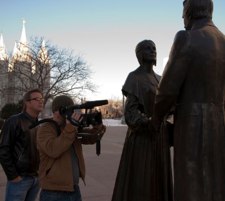
Reed Cowan didn't start out intending to lift the veil on his church. A born and bred Mormon -- with the education, two-year mission and perspective to show for it -- he had privately attempted to reckon his homosexuality with the less-than-tolerant teachings of the Church of Jesus Christ of Latter-Day Saints. But as a filmmaker and journalist for whom one treatment of the subject led to another, the development of Proposition 8 in 2008 proved the story -- and perhaps the message -- of a lifetime.
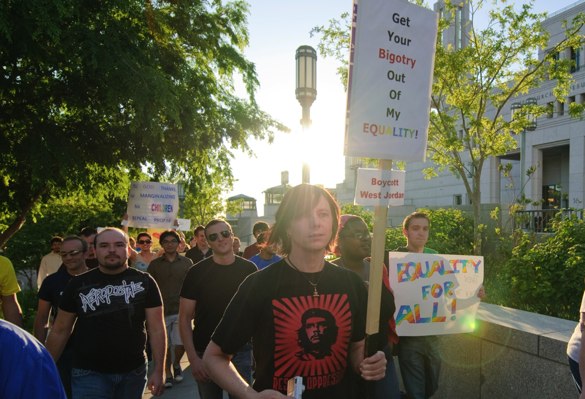
8: The Mormon Proposition is a devastating, damning study of the LDS' sordid record of dealing with its gay constituency. As if pouring millions of dollars and untold man-hours (much of it from out-of-state) into outlawing gay marriage in California weren't divisive enough, the church's history of excommunication, torture, electroshock, lobotomies (and worse, believe it or not) demonstrated its systemic interest in purging gays from its own ranks. Cowan explicitly illustrates that drive, unearthing the church records and members speaking to all manner of its philosophy -- spiritual and political -- for dealing with gay rights. From the homophobic rebukes of Utah State Sen. Chris Buttars to the ideological street duels ahead of the historic Nov. 4, 2008, vote (whose federal challenge makes continued progress this week), 8 showcases how and why one American institution got away with legislating morality.
Cowan spoke to Movieline about adjusting his original subject on the fly, the secret codes that rallied the Prop 8 base, and the one related, real-world application we can draw from Sex and the City 2.
How did you decide to make a film about Proposition 8?
Anybody who knows me I'm kind of a softie for kids -- especially young people who've been down the same roads as I have. And I didn't start out wanting to make a film about Proposition 8. I became aware a few years ago that Utah has the highest rate of not only teen suicide in the country, but also the highest rate of teen homelessness in the United States. And when surveyed, some 80 to 90 percent of those kids say they were kicked out of their homes after coming out. So we were in production on that documentary around the same time that Prop 8 was percolating. It was becoming evident that the Mormon Church had a pretty big hand in it -- we just weren't sure how extensive. So we backed off that angle when we thought, "The homelessness and the suicide we know about is the symptom of a greater problem." And what's the greatest manifestation of this problem? It's Proposition 8, the problem being bigotry spoken from the pulpit -- legislating against marginalized people from the pulpit. So that's where we started.
Yet some of the subjects in your film appear to have seen this coming. What were your thoughts as you realized the magnitude and scope of their story -- which was now your own?
First of all, a little background on me: I was schooled in the Mormon Parochial Seminary from seventh grade to 12th grade. I was schooled in the shadows of Brigham Young University at the Missionary Training Center, and then I served a two-year, door-to-door evangelical mission for the Mormon Church. So I saw what was going on relative to the political action. They were becoming something that I wasn't aware that they were.
Really? You never saw or sensed this side of the church as you grew up?
No. Honestly, every year -- and they still do this -- they read from the pulpit a letter from the first presidency of the church. They're like the grand poobah of the church. And it's spoken from the pulpit that our church does not advocates taking sides. Republican, Democrat. As a church, we remain neutral. So you hear that statement every year, and you think, "That's just how it is!" But when it became evident that they had put a call out to their members in California... On it's face, there were things that were clear to everybody. And then were thing that needed to be dug up. But they were using their Mormon-owned NBC affiliate in Salt Lake City to tell Utah Mormons to call their California relatives to get involved. And it looked like more than just a nudge to get involved. It was bigger than that. And I always say that journalists come into the Utah and they don't know what questions to ask because they weren't raised in the faith. I know the right questions to ask. And so when I, having been through the Mormon Temple -- where there's a code language used, where there are secret handshakes in the Temple, where there are secret ceremonies that go on there -- when I heard the code language used there in that call, I knew this was big.
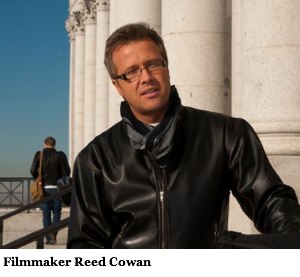
Exactly. In the Mormon secret ceremony, you're warned -- in fact you're taught by an actor who plays Satan himself -- that God will not be mocked. You will either abide by what you are committing to in this Temple or you will go to hell, and so will your entire family chain, so to speak. I heard this trigger language -- the "means and time" -- and I knew this was a holy war.
I wasn't sure you made the explicit connection between Mormons wanting gay marriage outlawed for consistency's sake: If they couldn't have polygamy, then gays couldn't have marriage. Is that an accurate read?
Well, the Mormons still believe in polygamy in the afterlife. So they still very much advocates for it in their rooms and their quiet [privacy]. When you peel back the root of it, they still believe that a man will become a God, have many wives, and populate a planet. The Mormon phrase is, "As man is, God once was. And as God is, man may become." The only utility in drawing that parallel was to say that, "Look, Mormons have been here too. They've practiced alternative marriage. And they of all people should be more sympathetic to the struggle." I don't know if you saw Sex and the City 2 -- or 3 or 4 or 5 or whatever they're on now -- but Carrie makes the point in the beginning: "Every relationship has the right to define itself." Mormons have the right to define their own relationships. Polygamy was frowned on by the general public -- and they were persecuted for it. Gay people have the right to define their own relationships as well. And Mormons of all people should be supportive of that rather than wage spiritual war on it.
The more you looked into this, were you surprised how unambiguous the church was about this movement -- and how little they really attempted to cover it up?
I think they were attempting to hide it, and that is what surprised me.
They had video, though. There was audio--
I feel like this was a lesson in the YouTube generation for Mormons. That video was released in a four-minute section on the Internet; we got the whole thing. And what you don't see in our film -- and I almost look back and wish we'd included it, but it's just too much -- is he starts out saying, "I want you to treat this broadcast as if I am in your hom, on your sofa, in your family room, with your family, having a private meeting. You, your family, and me, the apostle of God." So they set up this environment of secrecy in the broadcast. And I don't think they thought it would get out. I think they thought they could speak freely, and it would be safe.
What about the money trail? The records and plans and demands in writing?
I know they had no idea that a gay man would be working in their archive. The back story to these documents is that a young, gay man -- closeted, obviously -- was working in the church. His father was high up, so he was trusted with a certain level of access. He saw that the Mormon general authorities were -- and this is his account -- calling upon research about this same topic of gay marriage. So he went to those documents, photocopied them and left. I don't think they banked on ever having a gay employee who would say, "This is historically significant, and the public has to know about it." This young man told me that he wouldn't have done this if it had been about the secret practices in the Temple or anything sacred to Mormons. But because they made this incursion into public policy, he felt he had a right to take them because the American public deserved the right to know what was going on behind the scenes.
Are you surprised that despite all the focus on the Mormon Church during and after Prop 8, nothing's changed internally? Or is something changing?
I'm encouraged by the fact that the California Fair Political Practices Commission found them guilty of... what, some 13 counts in the last few days? They've been handily fined. I'm encouraged that our documents have wound up in the federal trial that's going on right now. As a result of our documents, other documents were subpoenaed. Attorneys knew there must be other documents, so they subpoenaed others, I've be told. I'm encouraged by the fact that transparency is beginning to happen. Because you know, as a journalist, that when you start to shine a light on something, the public will start to see it for what it is. I'm encouraged by that.
My friend!
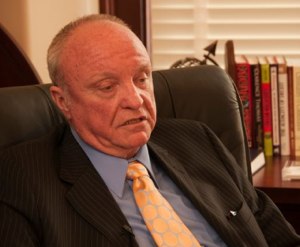
This guy fascinates me. And your reaction to him fascinates me. I totally understand dispassionately interviewing him, but as you realized the news this guy's comments will make, what were you thinking?
Well, I have to say that there is a part of yourself that's sitting there listening but reacting on a personal level. Sometimes you sit across from somebody you don't like and you ask questions. I guess I sat in that interview and I let him run his mouth -- I didn't have to ask a lot of questions. At the same time, the human being asking the questions was very hurt by what he said. But I couldn't react. I couldn't really jump him for what he was saying that would have ramifications in my life. Things that were so blatantly, horrifically offensive. He had a right to tell his story, and he did. And he had a right to expose himself such as he did.
The outrage of the period following Prop 8's passage was very intense. Yet it's long since tapered off, even as people remain angry about it.
Mm-hmm. It's an open wound.
Is political action so hot and fast now that it's impossible to sustain while we're off looking for the next movement?
I hope not. We're in danger of that, as with any movement. We're a culture that's quick to forget. I mean, look at Haiti. We held the telethons, and it was hot for a minute, but it was just a blip in the news cycle. How many journalists are in Haiti right now? My hope is that this documentary keeps it hotter for a little while longer -- that a few more eyeballs will be on it and a few more lessons can be learned. That's my hope.